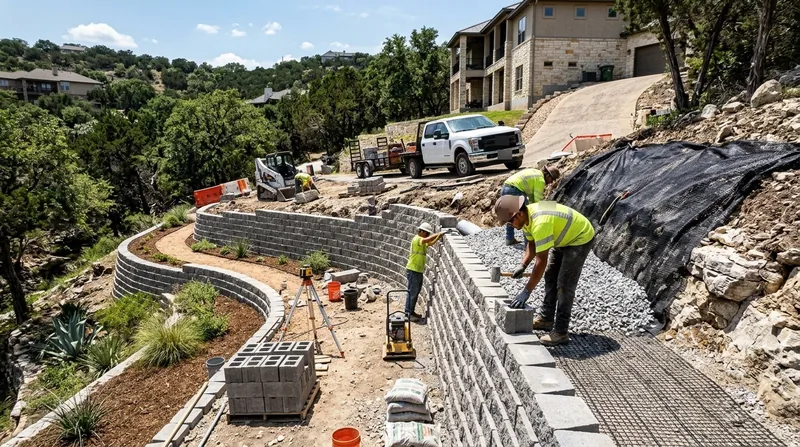




Block and segmental retaining walls in Austin are engineered mortarless systems that handle the unique demands of Central Texas terrain. From the thin limestone and clay soils west of MoPac to the expansive black prairie clay east of I-35, Austin homeowners face drainage challenges, seasonal clay movement, and flash flood pressures that require walls built to last. Segmental block systems like Allan Block, Versa-Lok, and Keystone offer flexibility for curves, terraces, and garden applications across subdivisions from Northwest Hills to Mueller and Windsor Park. These walls combine strength with aesthetic appeal, making them a practical choice for driveways, slope stabilization, and landscape terracing across the Austin area. We install, repair, and replace segmental block walls using engineered geogrid reinforcement and proper backfill drainage to prevent the failure modes that plague older timber and concrete walls in this climate.
Why Block and Segmental Retaining Walls Matter in Austin's Clay and Limestone Terrain
Austin's geography splits across the Balcones Escarpment, creating two distinct wall challenges. West of MoPac, hillside lots sit on thin rocky soil over Edwards limestone with steep driveways and cut-and-fill pads that demand structural walls. East of I-35, Blackland Prairie lots ride on expansive clay that swells after storms and shrinks in drought, heaving older poured concrete and timber walls. Segmental block walls with proper geogrid reinforcement and drainage handle both scenarios better than legacy materials. They flex slightly with soil movement, shed water effectively, and can be repaired section by section without total replacement.
- Mortarless block systems absorb minor soil settlement without cracking, unlike rigid poured concrete that fails under clay heave.
- Geogrid layers distribute load and resist sliding on slopes steeper than 1(V):2(H), critical for Northwest Hills and Westlake driveways.
- Engineered drainage behind the wall prevents the clogged backfill and Flash Flood Alley overload that collapse older walls.
- Segmental blocks allow curved and tiered designs that fit subdivision lot lines and aesthetic preferences without expensive custom forms.
- Failed sections can be rebuilt without disturbing the entire wall, reducing long-term repair costs on 20+ year old installations.
These advantages make segmental block the standard for new subdivision development and the preferred retrofit for failed timber and railroad tie walls throughout Austin and Round Rock.
Local context: The City of Austin and Travis County require permits for walls above roughly 4 feet measured from the footing, or when a wall supports a surcharge such as a driveway or structure. Engineered drawings are often required for tall or tiered walls. Always verify current thresholds with your local building department before design, as setback and property-line rules vary by jurisdiction. See the City of Austin Development Services for permit requirements in your zip code.
How We Install Block and Segmental Retaining Walls in Austin
A properly built segmental block wall starts below grade with a level, compacted base and ends above grade with controlled backfill and drainage. Our process begins with a site survey to assess soil type, slope angle, and water flow. We then design the wall height, block type, and geogrid spacing to meet the load and drainage demands of your lot. Installation follows engineered plans with step-by-step compaction, geogrid placement, and backfill management to ensure long-term stability on Austin's clay and limestone soils.
- We excavate and level the footing trench, removing soft clay and setting compacted base material to prevent settlement.
- First course of segmental blocks is set level and backfilled with engineered stone, creating a stable foundation for all courses above.
- Geogrid reinforcement is unrolled and anchored to each block course, extending into the retained soil to distribute load and resist sliding.
- Subsequent block courses are stacked with slight setback (batter) and backfilled with free-draining stone, never clay, to prevent saturation.
- A drainage pipe or fabric layer is installed behind the wall to direct groundwater and flash flood runoff away from the backfill.
- Top course is capped and graded to slope water away from the wall face, protecting the blocks from freeze-thaw and weathering.
This step-by-step approach prevents the failures we see in older walls: clay heave, geogrid pullout, and drainage collapse.
Example: A homeowner in Barton Hills with a failing 1980s timber wall replaced it with a 12-foot tiered segmental block wall using Keystone blocks and geogrid. The new wall accommodates a driveway surcharge, handles the limestone-to-clay transition in the soil, and includes a French drain to manage runoff from the hillside above. The project took 5 days and cost less than a full concrete replacement because no excavator or heavy crane was needed. See our full installation service page for more examples.
| Approach | Description | Best for |
|---|---|---|
| Allan Block (AB) | Interlocking rectangular blocks with textured face, 8 to 12 inches tall, designed for residential and light commercial use. | Garden walls, terraces, and low to medium height walls (up to 12 feet) in subdivision lots and residential driveways. |
| Versa-Lok | Solid concrete units with pin-and-slot connection, stackable to varied heights, available in multiple colors and finishes. | Curved walls, aesthetic applications, and sites requiring color matching to existing structures or HOA guidelines. |
| Keystone | Large-format modular blocks (up to 48 inches wide) with engineered batter, designed for tall walls and heavy surcharge loads. | Driveway retaining walls, slope stabilization on steep lots, and tiered terraces supporting structures or fill loads. |
| Geogrid Reinforcement | Polyester or polypropylene mesh layers placed horizontally between block courses to resist internal sliding and distribute load. | All segmental walls above 4 feet, walls on slopes steeper than 1(V):2(H), and any wall supporting a surcharge like a driveway. |
Block and Segmental Retaining Walls Cost in Austin: What to Expect
Segmental block retaining wall costs in Austin typically start at $25 per square foot for straightforward garden walls and terraces on level or gently sloping sites. A 20-foot long by 4-foot tall wall with single-course blocks runs roughly $2,000 to $2,500 before site prep or drainage upgrades. Costs rise with wall height, geogrid reinforcement, complex drainage, site access challenges, and soil conditions. A 12-foot tiered wall with engineered plans, heavy geogrid, and French drain on a steep Northwest Hills lot or Westlake hillside can reach $50 to $75 per square foot or higher, depending on excavation, fill removal, and structural requirements.
Several factors move the price up from that $25 baseline. Tall walls requiring engineered drawings and multiple geogrid layers add material and labor. Difficult site access, rocky limestone soil, or clay removal and replacement increase excavation time. Proximity to structures, driveways, or utilities requires more careful installation and potentially more drainage work. Flash Flood Alley properties east of I-35 often need enhanced drainage to prevent backfill saturation and wall failure, adding cost but preventing future repairs.
We recommend getting two to three estimates from licensed contractors before committing. Each estimate should itemize block type, geogrid layers, drainage provisions, and site-specific factors so you can compare apples to apples. Our free estimate process includes a site walk, soil assessment, and a realistic price range tied to your specific conditions. Call (737) 204-6261 for a no-obligation consultation, or visit our full pricing page for more detail on cost drivers and typical projects.
Block and Segmental Retaining Walls Near Me: What to Look for When Hiring a Contractor in Austin
Choosing the right contractor for your segmental block wall is as important as the materials themselves. Look for a company licensed and insured for retaining wall installation in Texas, with references from recent projects in your neighborhood or similar terrain. Ask to see examples of walls they have built on clay soil east of I-35 or limestone slopes west of MoPac, since those conditions demand different design and drainage strategies. Verify that the contractor understands local permitting, HOA requirements, and setback rules, and that they can provide engineered drawings if your wall exceeds 4 feet or supports a surcharge.
- Confirm the contractor holds a current Texas general contractor or specialty license and carries liability and workers compensation insurance.
- Ask for at least three references from walls installed in the past 2 years in Austin, Round Rock, Cedar Park, or similar Central Texas soil conditions.
- Request a detailed estimate that breaks down block type, geogrid layers, drainage method, and site preparation so you can compare multiple quotes.
- Verify that the contractor can obtain or coordinate permits with the City of Austin or your local building department, or explain which permits you must pull.
- Discuss warranty terms: reputable contractors guarantee their work for at least one year and stand behind material and labor defects.
We provide free estimates within 24 hours and handle all permitting coordination. Contact us at (737) 204-6261 to discuss your wall and get a firm price.
Block & Segmental Retaining Walls in Austin: Pricing Guide
| Service | Price | Details |
|---|---|---|
| Simple garden wall or terrace | Starting at $25/sq ft | Straightforward single or double-height segmental blocks on level or gently sloped sites with good drainage |
| Medium-height wall with geogrid and drainage | Starting at $40/sq ft | 4 to 8 foot walls with engineered geogrid reinforcement, French drain, and backfill on sloped or clay soil lots |
| Tall or tiered wall with engineered design | Starting at $60/sq ft | 8 to 15 foot walls with multiple geogrid layers, engineered drawings, complex drainage, and driveway or structure surcharge |
| Difficult access or rock excavation | On estimate | Narrow lots, limestone removal, or sites requiring specialized equipment and extended labor time need site assessment |
| Travel and site visit | Included | No mileage or travel charge for estimates and jobs within Austin and surrounding service areas |
| Free estimate | Free | Same-day or 24-hour response, no obligation to book, includes soil assessment and realistic price range |
Indicative pricing, the exact cost depends on square footage, finish, and site access. Free personalized estimate within 24h at (737) 204-6261.


