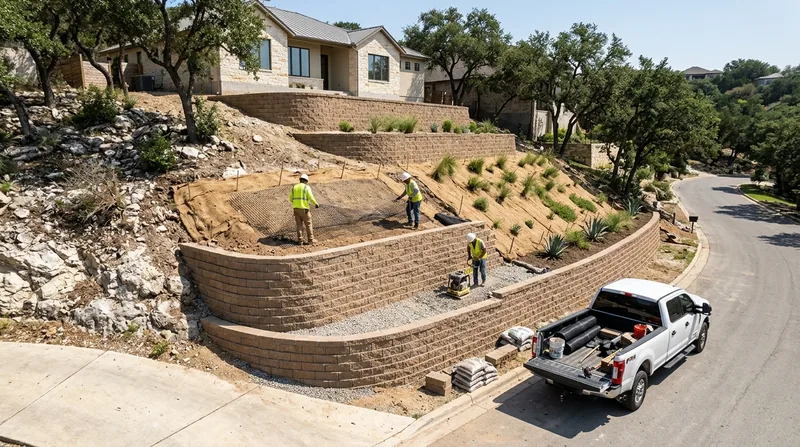




Austin's dramatic topography makes slope stabilization and erosion control essential for homeowners on the west side of MoPac and throughout the Hill Country. The Balcones Escarpment creates steep lots with thin rocky soil over Edwards limestone, while east of I-35, black expansive clay shrinks during drought and heaves after heavy rain. When these slopes fail, driveways crack, yards slide downhill, and foundations shift. We install terraced retaining walls, geogrid reinforcement, and drainage systems that stop soil movement before it damages your home. Read on to learn how slope stabilization works in Austin's unique geology, and call us at (737) 204-6261 for a free estimate.
Why Slope Stabilization Matters on Austin's Escarpment and Blackland Prairie
Austin's two distinct soil zones demand different stabilization strategies. West of MoPac, rocky hillside lots shed water quickly, leaving thin topsoil vulnerable to gullying and slumping. East of I-35, the Blackland Prairie's expansive clay absorbs water, swells, and then cracks open during dry spells, destabilizing anything built on top. Flash Flood Alley downpours overload poorly drained backfill behind old walls, triggering collapse. A failing slope doesn't just erode your yard, it undermines driveways, threatens utilities, and accelerates foundation problems. Proper slope stabilization and erosion control stops these failure modes before they become expensive structural repairs.
- We install terraced retaining walls that break long slopes into manageable segments, reducing stress on any single wall.
- We place geogrid reinforcement within the backfill to lock soil in place and prevent internal sliding.
- We design drainage systems that move water away from slopes instead of letting it accumulate and weaken the soil.
- We use native stone and block materials that match Austin's aesthetic while handling our intense sun and freeze-thaw cycles.
- We verify permit requirements with the local building department, since walls above 4 feet or supporting a surcharge typically need engineered drawings.
Each of these steps addresses the specific failure mode that dominates in Austin: clay heave, drought cracking, and flash flood saturation.
Key info: In Northwest Austin neighborhoods like Westlake and Barton Hills, we regularly stabilize slopes that support driveways and house pads cut into limestone. In Mueller and Windsor Park east of I-35, we combat heaving clay by installing deeper footings and perimeter drainage that keeps the Blackland Prairie clay from expanding under the wall.
For detailed guidance on permits and regulations, the City of Austin Development Services publishes wall setback and property-line rules; requirements vary by jurisdiction, so always confirm with your local building department before starting work.
How We Stabilize Slopes and Control Erosion in Austin
Slope stabilization begins with a site assessment. We measure the slope angle, identify the soil type (rocky limestone, clay, or mixed), check for existing drainage failures, and determine whether the slope supports a surcharge like a driveway or structure. From there, we design a tiered wall system with proper footings, backfill, and drainage. The goal is to stop soil movement, prevent water from accumulating behind the wall, and protect your home and yard for decades.
- We excavate and prepare the slope, removing loose soil and setting proper footing depth below the frost line.
- We build the first retaining wall with geogrid layers embedded in the backfill every 12 to 18 inches vertically.
- We install perforated drain pipe at the wall base, running water away from the slope to daylight or a swale.
- We backfill with compacted stone and soil, ensuring water drains freely and the wall can't be pushed by hydrostatic pressure.
- For steep or tiered slopes, we repeat this process with a second or third wall, creating a stable, attractive terraced landscape.
On a typical Northwest Austin hillside lot, we might install two terraced walls 8 to 12 feet apart, protecting a driveway and yard from slumping. In Mueller, we use deeper footings and heavier drainage to counteract the Blackland Prairie clay's heave potential. For more on the specific materials we use, see our pages on block and segmental retaining walls and retaining wall drainage.
Local example: A homeowner in Barton Hills had a 30-foot driveway that was cracking and settling as the limestone hillside slumped. We installed a 4-foot poured concrete retaining wall at the base with geogrid and a perimeter drain, then a 3-foot segmental block wall higher up. Three years later, the driveway is level, water drains away from the house, and the slope is stable.
Stabilization Methods and Materials for Austin Slopes
| Approach | Description | Best for |
|---|---|---|
| Terraced Poured Concrete Walls | Multiple concrete walls stacked on a slope, each with geogrid and drainage, creating a stepped effect. | Steep rocky hillsides in Westlake, Barton Hills, and Northwest Austin where durability and minimal maintenance matter. |
| Segmental Block Retaining Walls | Interlocking block units with built-in geogrid channels, stacked and backfilled with compacted stone. | Subdivisions and newer neighborhoods where a finished, modular appearance is preferred and slopes are moderate. |
| Boulder and Natural Stone Terraces | Large stacked limestone or granite boulders with soil and geogrid between layers, creating a naturalistic stepped landscape. | High-visibility slopes where aesthetic blending with natural stone surroundings is valued, common in Hill Country neighborhoods. |
| Geogrid Reinforced Soil Slopes | Layers of compacted native soil interspersed with geogrid fabric, creating a unified stabilized mass without a visible wall face. | Gentle slopes in the Blackland Prairie east of I-35 where heave risk is high and a soft, vegetated appearance is acceptable. |
| Perimeter Drainage and Swales | Perforated drain pipe and gravel trenches at the base of slopes, channeling water away to daylight or a storm drain. | All Austin slopes, especially those in Flash Flood Alley east of I-35, where water accumulation behind a wall is the primary failure mode. |
Each method is designed to address Austin's specific challenges: the limestone escarpment's rocky, thin soils; the Blackland Prairie's expansive clay; and the region's intense sun, freeze-thaw cycles, and flash flood risk.
Slope Stabilization and Erosion Control Cost in Austin: What to Expect
Slope stabilization pricing in Austin depends on slope length, height, soil type, and whether you need one wall or a terraced system. A single 4-foot retaining wall with drainage on a 20-foot slope might start around $4,000 to $7,000. A tiered two-wall system on a steep hillside can run $10,000 to $20,000 or more. Blackland Prairie slopes requiring deeper footings and heavy drainage may cost more than rocky escarpment sites because of soil conditions and excavation difficulty. We always provide a free estimate after visiting the site, so you know the exact scope and price before we begin.
The most important factors that move cost are:
- Slope length and height, since longer slopes need more wall length and more geogrid reinforcement.
- Soil type, because clay requires deeper footings and more robust drainage than rocky soil.
- Site access, since tight driveways or tree-filled yards slow equipment and increase labor.
- Material choice, with natural stone and boulder walls costing more than concrete or standard segmental block.
- Permit complexity, since engineered drawings for tall or tiered walls add design cost upfront but prevent costly mistakes.
Getting 2 or 3 estimates from licensed contractors is smart practice. Each will assess the site differently and may propose different solutions. For a detailed breakdown of our pricing and what's included at each level, visit our pricing page.
Slope Stabilization and Erosion Control Near Me: What Austin Homeowners Should Know When Hiring
Finding the right contractor for slope stabilization is as important as the design itself. A poorly built wall will fail within a few years, leaving you with a bigger problem and higher costs. Before you hire, verify that the contractor is licensed and insured, check references from recent Austin-area jobs, and understand the permit process for your specific property and neighborhood.
Key things to confirm:
- The contractor holds a valid Texas general contractor or specialty license and carries general liability and workers comp insurance.
- They can provide at least three references from homeowners in Austin or nearby areas where they've done slope stabilization or retaining wall work.
- They explain the permit threshold for your site and can handle applications if required by your city or county.
- They include drainage design as part of the estimate, not as an add-on, since water management is essential to long-term stability.
- They provide a written contract with a start date, completion timeline, and warranty on materials and workmanship.
HOA rules in subdivisions like Westlake, Barton Hills, and newer neighborhoods east of I-35 may restrict wall materials or height, so confirm those requirements before design work starts. Call us at (737) 204-6261 or request a free estimate online to discuss your slope and get a clear, no-obligation quote.
Slope Stabilization & Erosion Control in Austin: Pricing Guide
| Service | Price | Details |
|---|---|---|
| Single retaining wall, 4 feet tall, 20-30 feet long | Starting at $4,500 | Includes footing, wall, geogrid, backfill, and basic drainage for rocky or clay soils |
| Terraced two-wall system, moderate slope | Starting at $10,000 | Two walls with geogrid, perimeter drainage, and compacted backfill; typical for driveways and steep yards |
| Large or engineered slope stabilization | On estimate | Multi-tiered walls, extensive drainage, geotechnical analysis, and engineered drawings required for tall or complex slopes |
| Site visit and free estimate | Free | We assess slope angle, soil type, drainage needs, and permit requirements; response within 24 hours |
| Travel and mobilization | Included | No separate mileage or call-out fee for Austin and surrounding areas within our service zone |
| Permit and engineering drawings | Quoted separately | Required for walls over 4 feet or supporting a surcharge; cost depends on wall height and site complexity |
Indicative pricing, the exact cost depends on square footage, finish, and site access. Free personalized estimate within 24h at (737) 204-6261.


