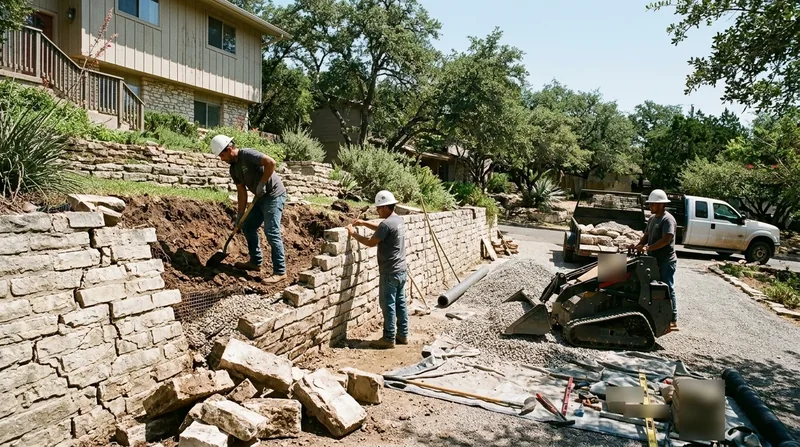




Retaining Wall Repair in Austin stops failure before it becomes collapse. Austin straddles the Balcones Escarpment, where hillside lots west of MoPac sit on thin rocky soil over Edwards limestone, and east of I-35, Blackland Prairie lots ride on black expansive clay that heaves in drought and swells after storms. Your wall leans, bows, cracks, or settles because of clay pressure, limestone erosion, clogged drainage, or the bright Central Texas sun baking out moisture. We diagnose the failure mode, fix the root cause, and stabilize the wall before your driveway drops, your foundation cracks, or your property line dispute becomes a lawsuit. Whether your wall is chopped Austin limestone, poured concrete, CMU block, segmental SRW, or rotting cedar and railroad ties from the 1970s, we repair it in place or rebuild it to code. Call us at (737) 204-6261 for a free estimate, or read on to understand what's wrong and how we fix it.
Why Retaining Wall Repair Matters in Austin: Clay Heave, Flash Floods, and Failing Drainage
Austin's two competing soil types and intense seasonal moisture swings create perfect conditions for wall failure. West of MoPac, thin limestone soil and steep slopes mean walls support heavy cut-and-fill loads and face seepage from ravine runoff. East of I-35, black expansive clay shrinks to concrete hardness in a drought, then swells after a Flash Flood Alley downpour, pushing walls sideways with tens of thousands of pounds of lateral force. Clogged or missing drainage behind a wall traps water, freezes it in winter, and amplifies clay heave. A wall that leans 2 inches this year may lean 6 inches next year and fail in the third, taking your driveway, fence, or neighbor's property with it.
- We identify the failure mode: clay heave, erosion, settlement, surcharge load, or drainage failure.
- We install or repair subsurface drainage, perforated pipe, and gravel backfill to stop water pressure.
- We install tieback anchors, deadman anchors, or soil nails to resist lateral push.
- We rebuild sections of wall that have bowed beyond safe limits, using modern block, poured concrete, or engineered systems.
- We verify setback and property-line compliance and obtain permits where required by your local jurisdiction.
Early repair costs far less than waiting for collapse, foundation damage, or neighbor claims. Check the Austin Development Services permit requirements for your wall height and surcharge conditions.
Key info: A limestone retaining wall in Westlake that leans 3 inches and shows vertical cracks is usually failing from clay heave or erosion underneath the footing. A CMU block wall in Mueller that bows outward and has horizontal cracks near the top is pushed by saturated black clay behind it. The fix depends on the cause, not just the symptom.
How We Repair Retaining Walls in Austin: Diagnosis, Drainage, and Rebuilding
We start with a free on-site inspection to read the wall. We photograph cracks, measure lean, probe the backfill and footing, and check for water seepage or soft soil. We ask about recent changes: new driveway, grading, or heavy rain. We determine whether the wall can be saved with drainage and anchors, or whether a section or the whole wall must be rebuilt. We explain the repair scope, timeline, and cost before we touch anything.
- We excavate behind the wall and remove failed backfill, exposing the footing and drainage plane.
- We install or repair perforated drain pipe at the footing level, sloped to daylight or a sump.
- We backfill with gravel, filter fabric, and compacted soil to restore stability and shed water.
- We install tieback anchors or soil nails if the wall is tall or supports a surcharge like a driveway.
- We rebuild bowed or cracked sections using block, poured concrete, or segmental systems, set on a stable footing.
- We finish the top with cap stone or concrete, and re-grade and seed the backslope.
A typical repair in Barton Hills or Cedar Park takes 3 to 7 days depending on wall length, access, and whether we rebuild. Learn more about retaining wall drainage solutions and how proper grading prevents future failure.
Local example: A 1960s limestone wall in Hyde Park was leaning 4 inches and had a 2-inch vertical crack running the full height. We excavated, found the footing had settled into soft clay, installed a perforated drain line and filter fabric, backfilled with compacted gravel, and installed two tieback anchors. The wall straightened, the crack closed, and the driveway stopped cracking. Cost was $4,200 for a 35-foot wall. Without repair, the next heavy rain would have pushed it into the neighbor's fence.
Repair Methods and Materials for Austin Retaining Walls
| Approach | Description | Best for |
|---|---|---|
| Drainage and Backfill Repair | Install perforated pipe, filter fabric, and compacted gravel behind the wall to stop water pressure and restore footing stability. | Walls with minor lean or cracking, saturated backfill, or clogged existing drainage. |
| Tieback and Soil Nail Anchors | Drill and grout steel rods or cables into stable soil or rock behind the wall, then attach them to the wall face to resist outward push. | Tall walls, walls supporting driveways or structures, or walls on steep slopes where setback prevents full rebuild. |
| Partial or Full Rebuild | Remove failed section or entire wall, set a new footing below frost and on stable bearing, and rebuild using concrete, block, segmental SRW, or stone. | Walls that bow more than 3 inches, have large cracks, or have failed footings; walls in Westlake or Barton Hills with limestone that has eroded. |
| Railroad Tie or Timber Replacement | Remove rotted cedar or railroad ties, set treated posts or segmental block in their place, and install proper drainage. | 1970s and 1980s timber walls that are settling, leaning, or showing rot; common in Zilker area and older North Austin neighborhoods. |
| Boulder or Stone Facing Repair | Reset loose boulders, repair mortar or grout, regrade backfill, and install drainage to stabilize natural stone terraces. | Boulder walls in Northwest Hills, Barton Hills, or Lakeway that have settled unevenly or have water seeping between stones. |
Retaining Wall Repair Cost in Austin: What to Expect
Retaining wall repair in Austin starts at $1,500 for minor drainage work or anchor installation on a short wall, and runs $3,500 to $8,000 for a 30- to 50-foot wall that needs drainage, backfill, and tieback anchors. Full rebuilds of a failed section cost $4,500 to $12,000 depending on wall height, length, material choice, and site access. A complex job on a steep lot with limited equipment access, or one requiring engineered drawings and permits, may cost more. The biggest variables are wall length, whether you rebuild or repair in place, and site conditions like rock, clay depth, and proximity to structures.
We recommend getting 2 to 3 estimates from licensed contractors in Austin. Compare scope of work, not just price. A cheap quote that skips proper drainage or footing work will fail again in 2 years. Ask about warranty, permit responsibility, and timeline. See our full pricing page for detailed breakdowns by wall type and scope.
Call us at (737) 204-6261 for a free estimate. We respond within 24 hours and provide a detailed quote with photos, scope, and timeline before you decide.
Retaining Wall Repair Near Me: What Austin Homeowners Should Know When Hiring a Contractor
Hiring the right contractor matters more than price. A wall repair is structural work, not cosmetic. Ask for a licensed, insured contractor who carries general liability and workers' compensation. Request references from recent Austin jobs, and call at least two. Ask whether the contractor obtains permits or whether you do. Many Austin jurisdictions require a permit for walls above 4 feet measured from the footing, or when a wall supports a surcharge like a driveway. Check with your local building department (thresholds vary by city). Ask about HOA requirements if you're in a managed community. Understand what happens if the contractor hits rock, finds soft soil, or discovers a property-line issue during the job.
- Get a written estimate that includes scope, materials, timeline, warranty, and permit responsibility.
- Ask for at least two references from retaining wall repairs completed in Austin in the past 12 months.
- Verify that the contractor will handle drainage design and proper footing depth, not just rebuild the visible wall.
- Clarify whether the job requires an engineer's stamp or city inspection, and who pays for those.
- Discuss site access, equipment staging, and whether you need to move vehicles or clear the backyard.
We handle all permits and city inspections for retaining wall work. We provide a free estimate with no obligation. Contact us online or call (737) 204-6261 to schedule your site visit.
Retaining Wall Repair in Austin: Pricing Guide
| Service | Price | Details |
|---|---|---|
| Drainage and Backfill Repair | Starting at $1,500 | Install perforated pipe and gravel backfill behind the wall; cost increases with wall length and excavation depth. |
| Tieback Anchors or Soil Nails | Starting at $2,500 | Drill and grout anchors to resist lateral push; price per anchor plus labor; typical job uses two to four anchors. |
| Partial Wall Rebuild | Starting at $4,500 | Remove and rebuild a failed section using block, concrete, or segmental SRW; cost depends on height, length, and material choice. |
| Full Wall Replacement | On estimate | Complete removal and rebuild of entire wall; requires on-site inspection to assess footing depth, soil conditions, and structural scope. |
| Travel | Included | No separate mileage fee within Austin and surrounding service areas; estimate includes site visit and written proposal. |
| Estimate | Free | On-site inspection, photos, written scope, and pricing; response within 24 hours; no obligation to book; call (737) 204-6261. |
Indicative pricing, the exact cost depends on square footage, finish, and site access. Free personalized estimate within 24h at (737) 204-6261.


