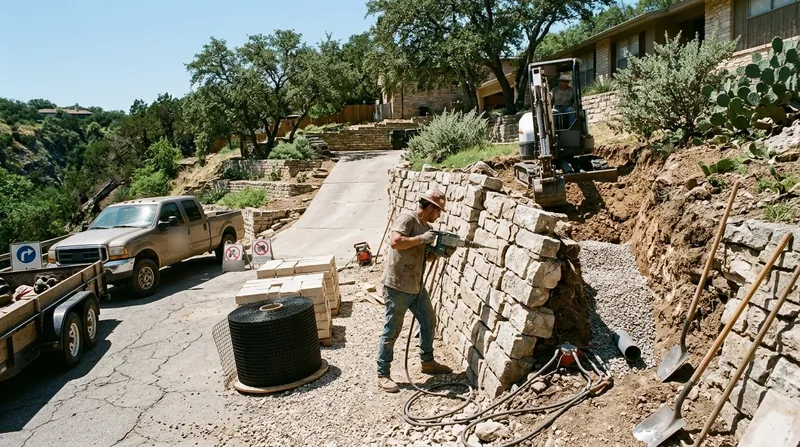




Leaning & Collapsed Wall Repair in Austin is a high-priority service for homeowners on the Balcones Escarpment west of MoPac and on the expansive clay lots of the Blackland Prairie east of I-35. Austin's geology and weather create two dominant failure modes: in the hillside neighborhoods of Northwest Hills, Westlake, and Barton Hills, thin rocky soil over Edwards limestone combined with steep driveways and cut-and-fill pads causes walls to lean and crack under load; in Mueller, Windsor Park, and older east Austin, black expansive clay swells after heavy rains and shrinks in drought, generating hydrostatic pressure that buckles and collapses walls built without proper drainage. Flash Flood Alley downpours routinely overwhelm clogged backfill, turning a stable wall into a dangerous bulge overnight. We respond to emergency calls, stabilize failing walls with tieback anchors and drainage correction, and rebuild when the damage is beyond repair. This page explains what causes these failures in Austin, how we fix them, and what to expect when you call.
Why Leaning and Bulging Walls Fail So Often in Austin
Austin's retaining walls fail faster and more dramatically than in most US cities because of the combination of clay heave, seasonal drought cracking, and intense summer storms. A wall that looks stable in July can lean visibly by September after a wet spell; a wall built on clay in the 1970s or 1980s without a drainage layer will eventually buckle under pressure from water trapped behind the backfill. The problem accelerates when homeowners ignore early warning signs: small horizontal cracks, a slight tilt, or soil settling away from the base. By the time the wall is visibly leaning, hydrostatic pressure or clay expansion has already done structural damage.
- Expansive clay in east and central Austin swells when wet and shrinks when dry, creating cyclic pressure that cracks and displaces wall footings.
- Clogged or missing drainage behind the wall allows water to accumulate, generating hydrostatic force that pushes the wall outward and downward.
- Shallow footings on rocky limestone soil or clay fail to anchor properly when the wall carries a surcharge like a driveway or structure.
- Aging timber and railroad tie walls from the 1960s-1980s rot from the inside out, losing structural integrity without visible external signs until collapse is imminent.
- Steep hillside cuts in Northwest Hills and Lakeway create unbalanced lateral loads that no single-wythe wall can resist without anchoring or buttressing.
Early detection and professional repair prevent catastrophic failure and protect your property line, driveway, and landscaping investment.
Key info: A wall leaning more than 1 inch per 10 feet of height is structurally compromised and requires immediate inspection. In Round Rock and Cedar Park, walls on clay lots often fail within 5 to 10 years of installation if drainage was not engineered properly. We have stabilized dozens of leaning walls in Westlake and Barton Hills using tieback anchors and French drain systems that cost far less than a full rebuild.
For detailed guidance on general wall repair, see our retaining wall repair page. For walls that cannot be saved, we also offer full replacement with modern drainage and engineering.
For permit and code information specific to Austin and surrounding jurisdictions, consult the City of Austin Development Services website, which publishes setback, height, and engineered drawing requirements for retaining walls above 4 feet.
How We Stabilize and Repair Leaning Walls in Austin
Our repair process begins with a site inspection and structural assessment. We measure the lean, probe the soil and footing, check for water accumulation or drainage failure, and document cracks and displacement. From that data, we recommend one of three paths: stabilization with anchors and drainage if the wall is structurally sound; partial rebuild if only the upper courses are damaged; or full replacement if the wall is past saving. Each approach is tailored to the wall's material (concrete, block, limestone, timber), height, and the surrounding terrain.
- We excavate and inspect the wall footing, backfill, and drainage to identify the root cause of failure (hydrostatic pressure, clay heave, poor compaction, or structural damage).
- We install tieback anchors, deadman anchors, or soil nails if the wall can be stabilized without full removal.
- We install or repair French drains, perforated pipe, and gravel backfill to relieve hydrostatic pressure and prevent future water accumulation.
- We rebuild the upper courses or the entire wall if anchoring alone cannot restore structural integrity.
- We backfill with compacted, well-draining material and test the new drainage system under simulated load.
The entire process typically takes 2 to 4 weeks depending on wall size, footing depth, and whether we need to relocate utilities or schedule around weather.
Local example: A homeowner in Barton Hills had a 12-foot limestone wall leaning 3 inches outward after a heavy spring storm. We installed two tieback anchors anchored 8 feet into stable limestone, added a French drain system along the base, and corrected the backfill. Total cost was $4,800. A full rebuild would have cost $12,500. The wall is now plumb and stable.
For more on drainage solutions, visit our retaining wall drainage page.
Repair Methods and When to Use Each
| Approach | Description | Best for |
|---|---|---|
| Tieback Anchors | Steel rods or cables anchored deep into stable soil or rock, then tensioned to pull the wall back into plumb. | Walls leaning 1 to 3 inches with sound footings and stable subgrade; common in Westlake and Barton Hills limestone. |
| Drainage Repair | Installation of French drains, perforated pipe, and gravel backfill to eliminate hydrostatic pressure behind the wall. | Walls failing due to water accumulation; essential for clay lots in Mueller and Windsor Park where swelling is the primary driver. |
| Partial Rebuild | Removal and reconstruction of the top 3 to 6 feet of wall courses while the lower footing and courses remain in place. | Walls with upper-course cracking, spalling, or displacement; footing is stable but the wall above is compromised. |
| Full Replacement | Complete removal and reconstruction of the wall with new footing, engineered drainage, and modern materials (concrete, block, or stone). | Walls beyond 5 to 7 degrees of lean; rotting timber or railroad tie walls; footing failure; or when local code requires engineered design. |
The right repair method depends on the wall's age, material, degree of failure, and soil conditions. We always recommend a free site inspection before committing to a repair plan.
Leaning & Collapsed Wall Repair Cost in Austin: What to Expect
Repair costs for leaning and collapsed walls in Austin range from $2,500 for stabilization with tieback anchors on a small wall to $15,000 or more for a full rebuild of a large, complex wall. The most common repair, drainage correction and one or two tieback anchors on a 10- to 15-foot wall, typically costs $4,000 to $7,000. Full replacement of a 20-foot wall with engineered footing and drainage runs $12,000 to $18,000 depending on material (concrete is less expensive than stone or block) and site access.
Several factors move the price up or down. Depth of footing and stability of subgrade are the biggest variables: a wall on shallow clay requires deeper anchoring than one on limestone bedrock. Access also matters: a wall accessible by truck costs less to repair than one on a steep hillside requiring hand labor and equipment hauling. Material choice (concrete, block, stone, or timber) affects both labor and material cost. Finally, if the wall supports a structure or driveway, or if local code requires an engineered design, the cost will include structural drawings and engineering review, adding $800 to $1,500.
We recommend getting 2 to 3 estimates from licensed contractors before committing. Each contractor should provide a detailed scope of work, material list, timeline, and warranty. Our free estimate is valid for 30 days and includes a written summary of findings and repair options.
For a full pricing overview and examples, visit our pricing page.
What to Look for When Hiring a Retaining Wall Contractor Near Me in Austin
Choosing the right contractor for leaning and collapsed wall repair is critical because improper repair can make the problem worse. A poorly installed tieback anchor or inadequate drainage will fail within 2 to 3 years, costing you twice as much for a second repair. When you are shopping for a contractor near Austin, Cedar Park, Round Rock, or Georgetown, focus on three things: licensing and insurance, references from recent Austin-area jobs, and a clear written estimate that explains the repair method and materials.
Ask for a certificate of insurance and verify coverage limits. Second, request references from at least two recent repairs in your zip code or neighborhood, and call those homeowners to ask about timeline, cleanup, and whether the wall has remained stable. Third, insist on a written estimate that lists the repair method, materials, labor, timeline, and warranty. Be wary of contractors who quote over the phone without a site visit or who promise a price that is 30 percent below the competition.
Check whether your city or county requires a permit for your wall repair. In Austin, walls above 4 feet or walls supporting a surcharge (driveway, deck, structure) typically require a permit. Your contractor should handle permitting and code compliance as part of the job. If your wall is in an HOA community, ask whether the HOA has design or material restrictions, and confirm with your contractor that the repair plan complies.
For more information or to request a free estimate, contact Austin Retaining Wall at (737) 204-6261. We respond within 24 hours and provide a detailed written estimate at no cost or obligation.
Leaning & Collapsed Wall Repair in Austin: Pricing Guide
| Service | Price | Details |
|---|---|---|
| Tieback Anchor Stabilization | Starting at $2,500 | Two anchors on a 10-foot wall with drainage repair and backfill; price increases with wall height and anchor depth |
| Drainage Repair and Backfill | Starting at $1,800 | French drain installation, perforated pipe, and gravel backfill for a 20-foot run; clay lots and wet sites cost more |
| Partial Rebuild (Upper Courses) | Starting at $5,500 | Removal and reconstruction of top 3 to 6 feet of wall; concrete block is less expensive than stone or timber |
| Full Wall Replacement | Starting at $10,000 | Complete removal, new footing, engineered drainage, and reconstruction; material and height drive final cost significantly |
| Structural Inspection and Estimate | Free | Site visit, footing and soil assessment, written repair recommendations, and cost estimate within 24 hours of call |
| Travel and Mobilization | Included | No travel charge for Austin, Round Rock, Cedar Park, Georgetown, and surrounding service areas within 20 miles |
Indicative pricing, the exact cost depends on square footage, finish, and site access. Free personalized estimate within 24h at (737) 204-6261.


