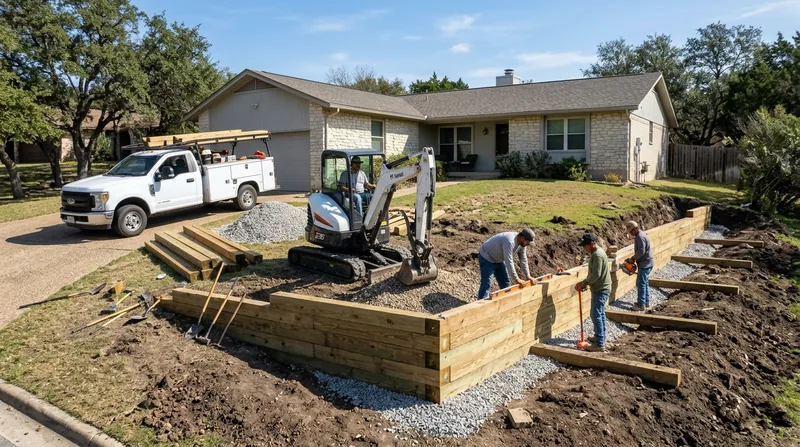




Timber retaining walls in Austin offer an affordable, flexible solution for garden beds, low terraces, and slope containment across the city's diverse neighborhoods. From the rocky hillsides west of MoPac in Northwest Hills and Westlake to the black clay prairie east of I-35 in Mueller and Windsor Park, timber walls provide quick installation and easy adjustment without the cost of poured concrete or segmental block. However, Austin's intense sun, seasonal drought cracking, and Flash Flood Alley downpours demand honest guidance on when timber makes sense and when a longer-lasting material protects your investment. We work with pressure-treated lumber to build durable, code-compliant walls that handle Austin's climate, and we're direct about timber's lifespan and maintenance so you can decide what's right for your property. Our crew installs, repairs, and replaces timber walls across Austin, Round Rock, Cedar Park, Georgetown, and surrounding areas, always with an eye toward proper drainage, soil conditions, and local permitting rules.
Why Timber Retaining Walls Matter in Austin's Landscape
Austin's neighborhoods span radically different soils and slopes. West of MoPac, thin rocky soil over Edwards limestone creates steep driveways and cut-and-fill pads where a quick, budget-friendly timber wall solves an immediate erosion or grade problem. East of I-35, black expansive clay swells after storms and shrinks in drought, making wall movement a constant challenge. Timber walls excel as temporary or semi-permanent solutions for garden beds, planter terraces, and low-rise containment where you don't need the permanence of stone or concrete, and where access or soil conditions make heavier materials impractical. Getting the right material choice upfront saves money and prevents costly repairs later.
- We use pressure-treated lumber rated for ground contact and Austin's UV exposure to extend wall life beyond untreated cedar.
- Timber walls cost significantly less per linear foot than concrete or segmental block, freeing budget for drainage and site prep.
- Installation is fast: we set posts, level beams, and backfill within days rather than weeks for engineered systems.
- Timber walls adapt easily to curved or terraced layouts that rigid systems struggle to match.
- Proper drainage behind timber walls prevents the clay heave and saturation failures that plague Austin's poorly drained sites.
When you need a wall that's affordable, quick to install, and honest about its trade-offs, timber is often the right call in Austin.
Key info: Timber retaining walls typically last 10 to 15 years in Austin's climate with proper maintenance and drainage. For longer-term solutions, especially on high-visibility or load-bearing sites, consider concrete retaining walls or boulder and natural stone walls. Always verify wall height and permit requirements with your local building department, as many jurisdictions require a permit for walls above roughly 4 feet.
For detailed permit guidance specific to your property, contact the City of Austin Development Services or your local jurisdiction's building department.
How We Install and Repair Timber Retaining Walls in Austin
Our process starts with a site assessment: we evaluate soil type, drainage patterns, slope angle, and any structures or utilities nearby. Austin's clay soils demand careful backfill compaction and perimeter drainage to prevent saturation and wall movement. We set pressure-treated posts on solid footings below the frost line, level the beams, and backfill with compacted gravel and soil in layers. Every installation includes a drainage plan because clogged or absent backfill is the number-one cause of timber wall failure in Central Texas. If you have an existing timber wall that's leaning, rotting, or failing, we assess the damage, reinforce or replace compromised sections, and improve drainage to stop the problem from recurring.
- We excavate and prepare the footing trench to proper depth and bearing capacity for your soil type.
- Pressure-treated posts and beams are set plumb and level, with proper spacing and fastening per code.
- We install perimeter drainage (gravel, perforated pipe, or fabric) to move water away from the wall and prevent clay saturation.
- Backfill is placed and compacted in 6-inch lifts to ensure stability and prevent settlement.
- We cap the wall with treated lumber or stone to shed water and protect the top from rot and weathering.
This methodical approach prevents the drainage failures and soil movement that plague rushed timber installations across Austin.
Local example: A homeowner in Barton Hills had a 3-foot cedar wall built in the 1980s that was leaning inward and rotting at the base. We removed the failing cedar, installed new pressure-treated posts and beams on a proper footing, added a perforated drain line along the back, and backfilled with compacted gravel. The new wall sits plumb, sheds water effectively, and will serve for 12 to 15 years with minimal maintenance. That's the difference proper drainage and solid footings make.
If your wall is showing signs of failure, we can often repair or reinforce it rather than rebuild. See our retaining wall repair page for details on leaning, rotting, and settling walls.
Timber Retaining Wall Methods and Materials
| Approach | Description | Best for |
|---|---|---|
| Pressure-Treated Posts and Beams | Posts (6x6 or 8x8) set in footings, horizontal beams (2x8 or 2x10) attached with bolts or lag screws, rated for ground contact and Austin UV. | Most Austin installations, low to mid-height terraces, garden beds, durable and code-compliant. |
| Stacked Timber Planks | Horizontal 2x10 or 2x12 planks stacked and held by vertical posts or pins, easier to adjust or remove later. | Temporary or semi-permanent walls, sites where future modification is likely, lower height constraints. |
| Timber with Geotextile Facing | Timber frame with landscape fabric stapled to the face to prevent soil from spilling through gaps and to reinforce the backfill. | Erosion-prone sites, clay soils that shed water poorly, areas with heavy runoff or slope instability. |
| Reinforced Timber with Deadman Anchors | Timber wall with buried horizontal anchors (deadmen) extending into the backfill to resist soil pressure and prevent outward movement. | Taller timber walls (4 to 6 feet), high clay content soils prone to heave, sites where durability is essential. |
Timber Retaining Walls Cost in Austin: What to Expect
Timber retaining wall pricing in Austin typically starts at $20 per square foot for basic installations with standard pressure-treated lumber and straightforward site conditions. The final cost depends on several concrete factors: wall height and length, soil type and bearing capacity, drainage requirements, site access and slope, proximity to structures or utilities, and whether you're installing new or replacing a failed wall. A simple 3-foot wall across a level backyard in Mueller might run $18 to $25 per square foot. A 5-foot terraced wall on a hillside in Westlake with poor drainage and difficult access could reach $35 to $45 per square foot because we must improve drainage, excavate more carefully, and stage materials differently. Getting two or three estimates from licensed contractors ensures you understand what's included and why prices vary.
We recommend calling (737) 204-6261 for a free, no-obligation estimate. We respond within 24 hours, visit your site, assess soil and drainage, and provide a detailed quote that reflects your actual conditions. See our full pricing overview for additional details on labor, materials, and drainage add-ons.
Timber Retaining Walls Near Me: What Austin Homeowners Should Know When Hiring a Contractor
Hiring the right contractor for a timber retaining wall ensures your wall is built to code, drains properly, and lasts as long as the material allows. Start by verifying the contractor is licensed and insured in Texas and carries general liability and workers' compensation coverage. Ask for references from recent timber wall projects in your neighborhood, call those homeowners, and ask specifically about drainage performance and whether the wall has settled or moved. Understand your local jurisdiction's permit requirements: many Austin neighborhoods, especially in Northwest Hills and Westlake, require a permit for walls above 4 feet or when a wall supports a surcharge like a driveway. If your property is in an HOA, check the architectural guidelines before design and installation begin. Get estimates in writing that itemize materials, labor, drainage, and site cleanup so you can compare apples to apples.
- Request at least three references from timber wall projects completed in the past two years in Austin or nearby areas.
- Ask whether the estimate includes drainage design, permit coordination, and site restoration after construction.
- Confirm the contractor will pull the necessary permits and coordinate with your local building department before work begins.
- Check your HOA covenants and architectural review process, and ensure the contractor understands any height, material, or setback restrictions.
A qualified, transparent contractor will answer these questions directly and provide a clear scope of work and timeline.
Ready to move forward? Contact us for a free estimate, or call (737) 204-6261 to discuss your timber wall project.
Timber Retaining Walls in Austin: Pricing Guide
| Service | Price | Details |
|---|---|---|
| Standard Timber Wall Installation | Starting at $20/sq ft | Pressure-treated posts and beams, proper footing, basic drainage, compacted backfill, typical Austin soil and access |
| Timber Wall with Enhanced Drainage | Starting at $28/sq ft | Includes perforated drain line, gravel backfill, geotextile fabric, recommended for clay soils and high water tables |
| Timber Wall Repair or Reinforcement | Starting at $25/sq ft | Assessment, partial or full replacement of rotting sections, improved drainage, foundation stabilization on existing walls |
| Terraced or Complex Multi-Level Timber Walls | On estimate | Height, slope angle, soil conditions, and site access vary widely; site visit required before pricing |
| Free Estimate and Site Assessment | Free | We visit your property, evaluate soil type and drainage, measure the wall area, and provide a detailed written quote within 24 hours |
Indicative pricing, the exact cost depends on square footage, finish, and site access. Free personalized estimate within 24h at (737) 204-6261.


