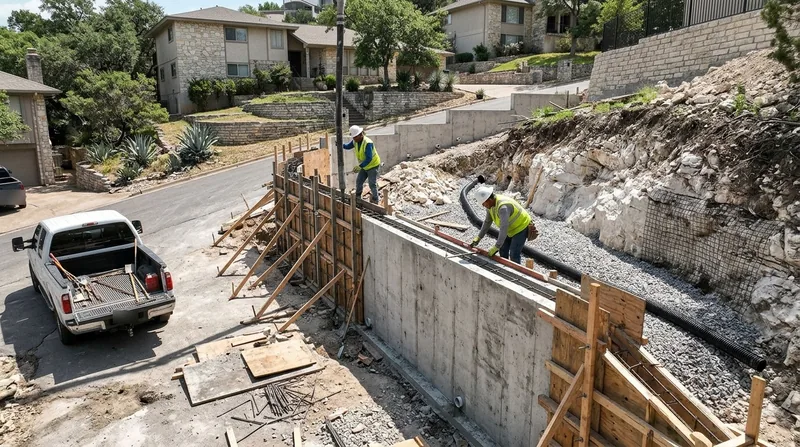




Concrete retaining walls in Austin are the strongest, most durable solution for the steep limestone lots, clay-heavy terrain, and intense weather that define Central Texas living. Whether you're stabilizing a driveway cut on the Balcones Escarpment west of MoPac, managing subsidence and clay heave on Blackland Prairie soil east of I-35, or replacing a failed timber wall that's been rotting for decades, poured concrete and reinforced CMU block walls deliver engineered protection that lasts 50+ years. Austin's landscape demands more than cosmetic landscaping: it demands walls built to code, anchored with proper footings below the frost line, reinforced with rebar, and equipped with weep holes and drainage to handle Flash Flood Alley downpours. We build concrete retaining walls that stop erosion, prevent property loss, and hold the line under Austin's unforgiving sun and soil. Call (737) 204-6261 for a free estimate, or learn more about retaining wall installation across the greater Austin area.
Why Concrete Retaining Walls Matter in Austin's Tough Terrain
Austin straddles two radically different geologies. West of MoPac, thin rocky soil sits directly over Edwards limestone bedrock, forcing steep driveways and cut-and-fill pads that need serious structural support. East of I-35, black expansive clay shrinks during drought and swells after heavy rain, creating heave pressure and foundation stress that breaks weaker walls. Both zones flood hard and fast during spring storms. A poorly built retaining wall fails catastrophically: it leans, cracks, collapses, and takes a driveway, fence, or worse with it. Concrete and reinforced CMU walls engineered to local soil and loading conditions stop that failure cold.
- We pour walls with engineered footings that reach below seasonal frost and expansive clay movement.
- We install rebar and internal reinforcement rated for the lateral pressure your specific soil generates.
- We build weep holes and drainage systems to shed water before it saturates backfill and creates hydrostatic pressure.
- We follow Austin and Travis County building codes for walls above 4 feet or walls that support a surcharge.
These walls do not lean, crack, or fail under Austin weather and soil conditions.
Key info: Many Austin jurisdictions (City of Austin, Round Rock, Cedar Park, Pflugerville) require a permit and engineered drawings for retaining walls taller than 4 feet or walls supporting a driveway or structure. Always check with your local building department before starting work. We handle all permitting and engineering coordination.
For more information on wall failure and repair, see our guide to leaning and collapsed wall repair.
How We Build Concrete Retaining Walls in Austin: Process and Engineering
A concrete retaining wall is not just a pour. It is a engineered structure that must account for your specific soil type, water table, slope angle, and load. We start with a site visit and soil assessment. We measure the cut height, determine what the wall will support (driveway, patio, landscaping), and identify drainage challenges. We then design a wall with the right footing depth, rebar schedule, and drainage strategy for your lot and Austin's climate. We pull permits, schedule the work, and execute the build in phases: excavation and footing prep, rebar layout and inspection, formwork setup, concrete pour, curing, and final drainage installation.
- We excavate to undisturbed soil below the frost line and any expansive clay zone.
- We set footings at the depth required by local code and soil bearing capacity.
- We lay and tie rebar in a pattern engineered for your wall height and backfill pressure.
- We set forms, pour concrete to grade, and finish to a professional appearance.
- We install weep holes, drainage rock, and French drain systems behind the wall.
- We backfill with proper drainage material, compact to code, and verify the wall is plumb and stable.
The entire process, from site assessment to final grading, ensures a wall that performs for decades.
Example: A homeowner in Northwest Austin (78704) had a rotted cedar retaining wall along a steep driveway cut. The wall leaned 6 inches out of plumb and water pooled at the base. We removed the old wall, excavated to bedrock, poured a 18-foot concrete wall with 2 feet of footing, installed rebar and weep holes, and graded a perimeter drain. The wall is now vertical, dry, and rated to support future fence or landscaping.
For more on wall drainage and water management, see retaining wall drainage.
Concrete Retaining Wall Methods and Materials
| Approach | Description | Best for |
|---|---|---|
| Poured Concrete | Monolithic wall cast in place with reinforcing rebar, engineered footing, and integral weep holes. Custom height and thickness. | Tall walls (8 ft+), high-load applications (driveway support), curved or complex geometry, maximum durability. |
| Reinforced CMU Block | Concrete masonry units stacked and mortared with rebar cores and bond beams. Faster than poured concrete, still fully engineered. | Medium walls (4 to 10 ft), where appearance or modular construction is preferred, good for Austin's limestone aesthetic. |
| Tiered/Stepped Walls | Multiple shorter walls stacked on independent footings, each with its own drainage, reducing pressure on any single wall. | Very steep slopes, areas where a single tall wall would exceed code or soil bearing limits, multi-level terracing. |
| Hybrid Concrete + Stone Veneer | Poured or CMU core with Austin limestone or natural stone facing for aesthetics and durability in visible areas. | Front yards, visible from street, homeowners wanting Austin limestone character with concrete strength underneath. |
Concrete Retaining Walls Cost in Austin: What to Expect
Concrete retaining wall pricing in Austin starts at $35 per square foot for straightforward poured concrete walls on accessible sites with standard soil and no major drainage complexity. That baseline assumes a wall 4 to 8 feet tall, properly engineered footing, rebar, weep holes, and basic backfill and grading. Height is the largest cost driver: a 10-foot wall costs more per square foot than a 4-foot wall because the footing must go deeper and rebar density increases. Site access matters too. A wall on a flat, open lot costs less than a wall on a steep, boulder-strewn slope or one requiring tree removal or heavy equipment rental. Soil type and drainage requirements add cost. If your lot has poor drainage, a French drain system or expanded gravel backfill will increase the total. Aesthetic upgrades like stone veneer or custom finishes add 15 to 30 percent.
A typical 30-foot-long, 6-foot-tall concrete wall in Cedar Park or Round Rock runs $6,300 to $8,500 installed. A 50-foot wall with tiered sections and French drainage in Pflugerville or Leander might run $12,000 to $18,000. The best way to lock in accurate pricing is to get 2 to 3 estimates from licensed, insured contractors who will visit your site, assess soil and drainage, and factor in local permit requirements. We offer free estimates within 24 hours. Call (737) 204-6261 or visit our pricing page for a detailed breakdown by wall type and height.
Concrete Retaining Walls Near Me: What Austin Homeowners Should Know When Hiring
Not all retaining wall contractors in Austin are created equal. Some cut corners on drainage, undersize footings, or skip engineering to save money and time. A failed wall can cost $10,000 to $20,000 to repair or replace, so hiring the right contractor the first time is critical. Start by verifying that any contractor you interview is licensed and insured for concrete work and retaining wall construction in Texas. Ask to see their general liability and workers compensation certificates. Get references from at least two recent Austin-area retaining wall jobs and call those homeowners. Ask whether their wall stayed dry, stayed plumb, and whether the contractor was professional and on time. Understand that walls above 4 feet or supporting a surcharge require a permit and, often, engineered drawings. A contractor who does not mention permits or engineering is cutting corners. Finally, check whether your HOA has approval requirements or deed restrictions on retaining walls. Some neighborhoods in Barton Hills, Westlake, and Lakeway have architectural review boards.
- Request and call references from retaining wall jobs completed in the last 12 months in Austin, Round Rock, or Cedar Park.
- Ask whether the contractor will pull permits and coordinate with the local building department.
- Verify that the estimate includes engineering, footing depth, rebar, weep holes, and drainage material.
- Get the estimate in writing with a timeline and payment schedule clearly stated.
Contact us for a free, no-obligation estimate and references.
Concrete Retaining Walls in Austin: Pricing Guide
| Service | Price | Details |
|---|---|---|
| Poured Concrete Retaining Wall | Starting at $35/sq ft | Includes engineered footing, rebar, weep holes, and standard backfill. Height and site access are primary cost drivers. |
| Reinforced CMU Block Wall | Starting at $32/sq ft | Concrete masonry units with rebar cores and bond beams. Faster installation than poured concrete for medium heights. |
| Tiered or Multi-Level Walls | On estimate | Multiple independent walls require separate footings and drainage. Site assessment needed to price accurately for your slope. |
| Stone Veneer or Aesthetic Finish | Add 15 to 30 percent | Austin limestone or natural stone facing adds material and labor cost but improves curb appeal and weather resistance. |
| Permitting and Engineering | Included | We handle all permit coordination and provide engineered drawings required by Austin, Round Rock, Cedar Park, and other local jurisdictions. |
| Free Estimate | No charge | Site visit, soil assessment, and written quote within 24 hours. No obligation to book. Call (737) 204-6261. |
Indicative pricing, the exact cost depends on square footage, finish, and site access. Free personalized estimate within 24h at (737) 204-6261.


