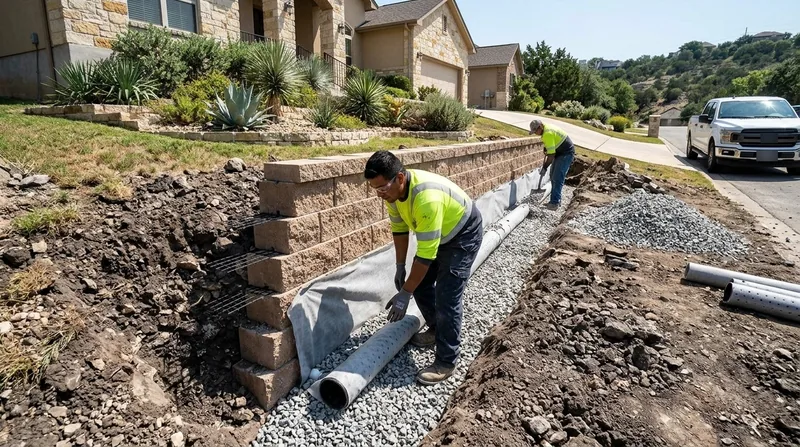




Retaining wall drainage in Austin is the difference between a wall that lasts decades and one that fails in five years. Austin's dual geography, from the rocky Edwards limestone hillsides west of MoPac to the black expansive clay prairies east of I-35, creates two distinct drainage nightmares: hillside walls face saturation from heavy rains that percolate through thin soil and hit limestone bedrock, while clay-lot walls endure hydrostatic pressure from clay that swells after Flash Flood Alley downpours and shrinks in drought. Without proper drainage, water builds up behind the wall, pushes laterally, and eventually tips or cracks the structure. We install and repair French drains, weep holes, gravel backfill systems, and waterproofing membranes that relieve that pressure before it destroys your wall. The result: a wall that holds the slope and protects your foundation, driveway, or landscape investment for 20, 30, or 40 years.
Why Retaining Wall Drainage Fails in Austin's Climate and Terrain
Austin sits at the edge of the Balcones Escarpment, where geology and weather collide. West of MoPac, thin rocky soil over limestone means water drains fast on the surface but pools behind retaining walls because the limestone bedrock itself sheds water. East of I-35, black Blackland Prairie clay is expansive: it swells when wet and shrinks when dry, creating immense lateral pressure against any wall holding it back. When a summer thunderstorm dumps two inches of rain in thirty minutes, that water has nowhere to go except into the backfill, where it builds hydrostatic load. Hydrostatic pressure is the number one cause of retaining wall failure in this region. A wall without drainage cannot handle the weight of saturated soil. It leans, cracks, bulges, or collapses.
- Saturated backfill behind a wall exerts up to three times the pressure of dry soil, overwhelming the wall's lateral strength.
- Clay heave from seasonal swelling and shrinking forces walls outward, especially in drought followed by heavy rain cycles common in Central Texas.
- Clogged or missing drainage systems trap water that freezes in rare cold snaps and expands, cracking concrete and stone.
- Older walls, especially 1970s railroad tie and cedar timber walls throughout Hyde Park and East Austin, rot faster when drainage fails because water sits against the wood year-round.
All of these failures are preventable with proper drainage installed at the time of wall construction or retrofitted during repair.
Austin's drainage challenge: A 2023 survey by the City of Austin Building Services noted that over 60 percent of residential retaining wall failures in the city stem from inadequate or failed drainage systems, not from poor construction alone. This makes drainage design as critical as the wall material itself.
For more on how walls fail and how we repair them, see our retaining wall repair page.
How We Install Retaining Wall Drainage Systems in Austin
Proper drainage begins before we pour concrete or set the first block. We excavate behind the wall line, install a gravel bed to allow water to flow freely, add a perforated drain pipe that carries water away from the wall, and cover it all with landscape fabric and more gravel so soil doesn't clog the system. For walls taller than 4 feet or supporting a surcharge like a driveway, we may add a waterproofing membrane on the wall face itself to prevent water from ever entering the backfill. The goal is simple: water must move down and away, never pooling or building pressure.
- We assess the site slope, soil type, and water table to determine whether a simple French drain or a more complex system with a membrane and sump is needed.
- We excavate the backfill area behind the wall and install a perforated PVC drain pipe at the base, sloped to daylight or to a dry well or storm drain.
- We place a gravel layer around and above the drain pipe to allow water infiltration while keeping soil out of the pipe.
- We install landscape fabric between the gravel and the native soil to prevent sediment migration and clogging.
- We add weep holes through the wall face itself, typically every 4 to 6 feet horizontally and 2 to 3 feet vertically, so any water that does enter the backfill can escape rather than build up.
- For tall or engineered walls, we apply a waterproofing membrane to the wall face before backfilling, creating a complete barrier.
The entire system works together to eliminate hydrostatic pressure and keep your wall dry and stable for decades.
Real Austin example: A Northwest Hills homeowner had a 6-foot poured concrete retaining wall holding back a clay-heavy slope above her driveway. After three seasons of heavy rain, the wall bulged outward nearly two inches. We removed the old, clogged backfill, installed a new perforated drain pipe sloped to daylight, wrapped it with gravel and fabric, and added weep holes every 5 feet. The wall straightened over the next year as the backfill dried out, and it has remained stable for over four years with no further movement.
See our retaining wall installation service for new wall builds that include proper drainage from day one.
Retaining Wall Drainage Methods and Materials
| Approach | Description | Best for |
|---|---|---|
| French Drain with Perforated Pipe | Perforated PVC drain pipe installed at the base of the wall, surrounded by gravel and landscape fabric, sloped to daylight or dry well. | Most retaining walls in Austin; standard for residential installations and the backbone of any drainage system. |
| Weep Holes | Small openings (typically 3-4 inch diameter) drilled or cast through the wall face, spaced every 4 to 6 feet horizontally and 2 to 3 feet vertically, allowing trapped water to escape. | Existing walls with early signs of hydrostatic pressure; quick retrofit to existing poured concrete or block walls. |
| Waterproofing Membrane | Rubberized or synthetic membrane applied to the wall face before backfilling, creating a complete water barrier; works with a French drain system behind it. | Tall walls (over 6 feet), walls supporting heavy surcharge (driveway, structure), or sites with very poor drainage or high water table. |
| Gravel Backfill and Fabric Layer | Replacing native clay backfill with clean, angular gravel and landscape fabric to allow water to percolate freely without soil clogging the drain system. | All walls; essential foundation of any drainage strategy, especially in clay-heavy Austin soil. |
| Sump Pit and Pump System | A collection pit at the base or downslope of the wall where drain water is gathered and then pumped away via a submersible pump, useful when daylight drainage is not possible. | Low-lying sites, sites where water cannot be daylighted downslope, or where a dry well is impractical. |
Retaining Wall Drainage Cost in Austin: What to Expect
Drainage work on a retaining wall typically starts at $2,500 for a basic French drain retrofit on a short to medium wall (under 4 feet, good site access). That price covers excavation of the backfill, installation of perforated drain pipe, gravel, landscape fabric, and proper slope to daylight. For a taller wall, a wall with poor access, or a site requiring a waterproofing membrane, costs climb to $4,500 to $8,000 or more. A wall requiring a sump pit and pump system, or one on a property with very limited downslope drainage, may run $6,000 to $10,000. The key factors that move the price are wall height, backfill volume, site access, soil conditions, and whether the wall is new construction or an existing retrofit.
Always get two or three estimates before committing. Site conditions vary wildly across Austin's diverse terrain: a hillside lot in Westlake with limestone bedrock and good drainage daylight is a fast job, while a flat Mueller lot with clay and poor outfall requires more planning and sometimes a pump system. Our pricing page breaks down typical scenarios and what moves costs up or down. Contact us for a free, no-obligation estimate and we will give you a firm number after seeing the site.
What to Look for When Hiring a Retaining Wall Contractor Near Me in Austin
Hiring the right contractor for drainage work is critical because bad drainage design or installation will fail silently for a year or two, then catastrophically. Look for a contractor who is licensed and insured in Texas, who has installed drainage systems in Austin's specific soil and climate conditions, and who can explain exactly how water will leave your wall and where it will go. Ask for references from recent drainage jobs in your neighborhood, especially if your lot is in a similar terrain (hillside vs. prairie clay). Verify that the contractor understands local permitting: walls over roughly 4 feet or supporting a surcharge often require a permit and may require engineered drawings. Check with your HOA if you live in a deed-restricted community, as some require pre-approval or specific wall materials. Finally, get the drainage plan in writing, including pipe size, slope, daylight location or sump details, and weep hole spacing.
- Ask for at least three references from drainage installations completed in the past three years in Austin or surrounding areas.
- Request a written drainage plan showing pipe size, slope direction, daylight outlet or sump location, and weep hole layout.
- Verify that the contractor has submitted to and received approval from the local building department if your wall requires a permit.
- Clarify warranty terms: reputable contractors typically guarantee their drainage work for at least two to three years against leaks or system failure.
A contractor who rushes the job, skips the French drain, or simply backfills with native clay is not worth the savings. Proper drainage is invisible when it works and catastrophic when it does not. Call us at (737) 204-6261 for a free estimate and a detailed drainage plan tailored to your site.
Retaining Wall Drainage in Austin: Pricing Guide
| Service | Price | Details |
|---|---|---|
| French Drain Retrofit (under 4 feet) | Starting at $2,500 | Perforated pipe, gravel, fabric, and daylight slope; includes excavation and backfill compaction for accessible walls |
| Medium Wall with Weep Holes (4-6 feet) | Starting at $4,000 | French drain plus weep hole drilling or casting; site access and soil type determine final cost within this range |
| Tall or Engineered Wall with Membrane (6+ feet) | Starting at $6,500 | Waterproofing membrane, full French drain system, weep holes, and reinforced gravel backfill; complex sites or poor drainage outfall increase price |
| Sump Pit and Pump System | Starting at $5,500 | Collection pit, submersible pump, and discharge line; necessary when daylight drainage is impossible or water table is high |
| Travel and Site Visit | Included | No mileage fees or travel charges within Austin and surrounding service areas; estimate response within 24 hours |
| Free Estimate | No charge | On-site assessment, drainage plan review, and written quote with no obligation to hire; call (737) 204-6261 |
Indicative pricing, the exact cost depends on square footage, finish, and site access. Free personalized estimate within 24h at (737) 204-6261.


