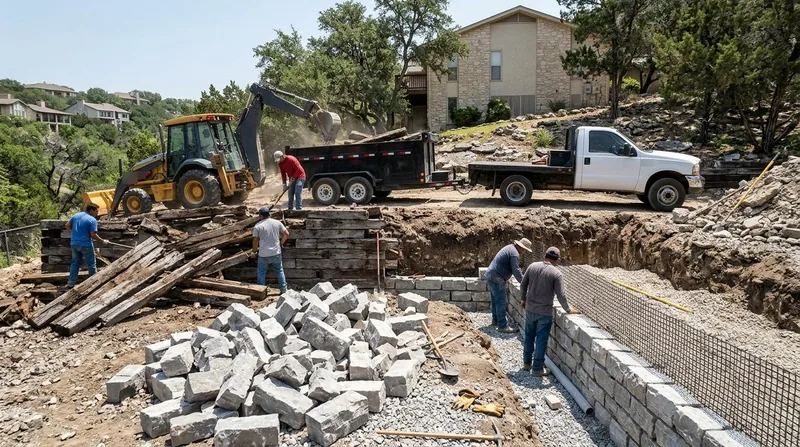




Austin's landscape straddles two geologies that demand different retaining wall strategies. West of MoPac, hillside lots in Northwest Hills, Westlake, and Barton Hills sit on thin rocky soil over Edwards limestone, with steep driveways and cut-and-fill pads that need engineered support. East of I-35, the Blackland Prairie runs on black expansive clay that heaves in drought and swells after heavy rain. Both conditions fail walls. The bright Central Texas sun, Flash Flood Alley downpours, and decades of aging timber and railroad tie walls mean Retaining Wall Replacement in Austin is not cosmetic work, it is structural rescue. When a wall leans, cracks, or collapses, replacement is the only fix that restores safety and property value. Austin Retaining Wall handles full tear-out, haul-away, new drainage, and modern engineered materials. Call (737) 204-6261 for a free estimate, or learn more about our retaining wall repair and installation services.
Why Retaining Wall Replacement Is Critical in Austin's Extreme Terrain and Clay Soils
Austin walls fail for reasons specific to this region. Expansive clay shrinks and heaves with drought and flood cycles, cracking poured concrete and shifting segmental block. Limestone hillsides shed water fast, overloading backfill and causing hydrostatic pressure that pushes walls outward. Timber and railroad tie walls from the 1970s rot in our humid summers and crack in our intense sun. A failed retaining wall does not stabilize on its own, it accelerates. Once it leans, cracks, or bows, replacement is the only safe option.
- We remove the entire failed structure, including roots, concrete footings, and compacted soil.
- We install new drainage systems to manage water and prevent hydrostatic pressure buildup.
- We rebuild with engineered materials sized for Austin's clay heave and flood loads.
- We obtain all required permits and coordinate with local building departments for walls above 4 feet.
- We haul away all debris and restore the site for new landscaping or hardscape.
Replacement is faster and more cost-effective than repeated repairs on a failing wall.
Key info: A leaning or cracked wall in a Westlake or Barton Hills driveway can fail catastrophically in the next heavy rain. Replacement prevents property damage, injury, and liability. Austin building code requires permits for walls above roughly 4 feet from footing, or when a wall supports a driveway or structure. Always verify current thresholds with the local building department.
For more on damaged walls, see our page on leaning and collapsed wall repair.
How We Replace a Failing Retaining Wall: The Austin Retaining Wall Process
Replacement starts with a site visit and structural assessment. We measure the wall, check drainage, examine soil conditions, and identify what caused the failure. Clay heave, water saturation, poor backfill, or tree roots are common culprits in Austin. We then design a new wall with proper footing depth, drainage, and material choice for your soil type and load. Once permits are secured, we demolish the old wall, haul debris, prepare the base, and install the new structure. The entire job, from estimate to completion, typically takes 2 to 4 weeks depending on wall size and site access.
- We conduct a free on-site evaluation and discuss failure causes and replacement options with you.
- We prepare engineered drawings if required by the building department and submit for permits.
- We schedule demolition and coordinate site access, parking, and utility locates.
- We remove the old wall, footing, and compacted backfill, then haul all debris off-site.
- We prepare the base, install new drainage rock and perforated pipe, and set the new wall to proper height and grade.
- We backfill with engineered soil, compact in lifts, and restore the surface for landscaping.
This methodical approach ensures your new wall will last decades and handle Austin's climate extremes.
Local example: A cedar retaining wall in Mueller that rotted after 25 years took 3 days to demolish and 5 days to rebuild with segmental block and proper drainage. The homeowner paid for removal of 12 cubic yards of debris and got a 50-year wall in its place. Similar jobs in Pflugerville and Round Rock follow the same timeline and scope.
Learn more about our retaining wall installation methods and material options.
Replacement Methods and Materials for Austin Retaining Walls
Not all walls are replaced with the same material. Your choice depends on soil type, wall height, budget, and aesthetic preference. Concrete, segmental block, natural stone, and engineered timber each have strengths in Austin's climate. Concrete poured in place is durable but can crack in expansive clay. Segmental block drains well and is easier to repair. Boulder and limestone walls suit hillside lots and blend with the natural landscape. Timber walls are less common for replacement because rot is inevitable in our heat and humidity, but they remain an option for short, non-structural terraces.
| Approach | Description | Best for |
|---|---|---|
| Poured Concrete | Monolithic wall cast in place with rebar and proper footing, finished smooth or textured. | Tall walls, high loads, driveways, and applications where a single rigid structure is required. |
| Segmental Retaining Wall (SRW) Block | Interlocking concrete units stacked with geogrid reinforcement and proper drainage behind. | Medium walls, residential lots in newer subdivisions, areas where repair or future adjustment may be needed. |
| Boulder and Natural Stone | Large stacked limestone or granite boulders mortared or dry-stacked with crushed stone backfill. | Hillside terraces, heritage lots, applications where natural appearance matches the landscape. |
| Engineered Timber or Composite | Pressure-treated lumber or composite boards with steel posts and deadman anchors, designed for drainage. | Short retaining walls, terraces, raised beds, and non-load-bearing applications where aesthetics favor wood. |
Retaining Wall Replacement Cost in Austin: What to Expect
Retaining wall replacement cost in Austin typically starts at $35 per square foot for straightforward segmental block or poured concrete walls on level sites with good access. A 40-foot wall, 4 feet tall, runs roughly 160 square feet and costs between $5,600 and $8,000 depending on material and drainage complexity. Taller walls, hillside sites with difficult access, or walls requiring engineered drawings push costs higher. Removal and haul-away of the old structure add $1,500 to $3,000. New drainage rock, perforated pipe, and soil preparation add another $800 to $1,500. Permitting and inspections are typically included in our estimate.
The best way to know your actual cost is to request a free estimate. Site conditions matter: a wall in a tight backyard in Barton Hills costs more than one on a flat lot in Pflugerville. We recommend getting 2 to 3 estimates from licensed contractors so you can compare scope, materials, and timeline. Never choose based on price alone, choose based on experience, insurance, and references.
For detailed pricing on different wall types and sizes, visit our full pricing page.
Retaining Wall Replacement Near Me: What Austin Homeowners Should Know When Hiring a Contractor
Hiring the right contractor for retaining wall replacement protects your investment and ensures the work meets code. Start by verifying that the contractor is licensed and insured. In Texas, retaining wall work does not require a specific trade license, but the contractor must carry general liability and workers compensation insurance. Ask for proof of insurance and check references from recent jobs in your neighborhood. Call 2 or 3 references and ask specifically about drainage performance after heavy rain and whether the wall has settled or cracked. Request a written estimate that breaks down labor, materials, permits, and haul-away so you know what you are paying for.
Understand your local permit requirements. Many Austin jurisdictions require a permit for walls above 4 feet or when a wall supports a surcharge such as a driveway. Some neighborhoods have HOA rules about wall materials or height. Always defer to your local building department for current thresholds, as they vary by jurisdiction. A good contractor will handle permitting or guide you through the process. Ask whether engineered drawings are required for your wall height and soil type. Do not skip this step, it protects you if the wall fails.
We provide free estimates within 24 hours and answer all questions about permits and materials. Contact us today for a no-obligation consultation, or call (737) 204-6261.
Retaining Wall Replacement in Austin: Pricing Guide
| Service | Price | Details |
|---|---|---|
| Segmental Block or Poured Concrete Walls | Starting at $35/sq ft | Includes demolition, new footing, drainage, backfill, and compaction for standard residential walls on level sites |
| Boulder or Natural Stone Walls | Starting at $50/sq ft | Higher cost reflects material sourcing, hand placement, and skilled labor required for hillside and heritage applications |
| Engineered Timber or Composite Walls | Starting at $40/sq ft | Includes pressure-treated lumber or composite boards, steel posts, anchors, and specialized drainage for short terraces |
| Difficult Access or Hillside Replacement | On estimate | Steep slopes, tight backyards, or proximity to structures require equipment rental and additional labor time on-site assessment |
| Estimate and Site Visit | Free | Response within 24 hours at (737) 204-6261, includes structural assessment and material recommendations no obligation |
Indicative pricing, the exact cost depends on square footage, finish, and site access. Free personalized estimate within 24h at (737) 204-6261.


