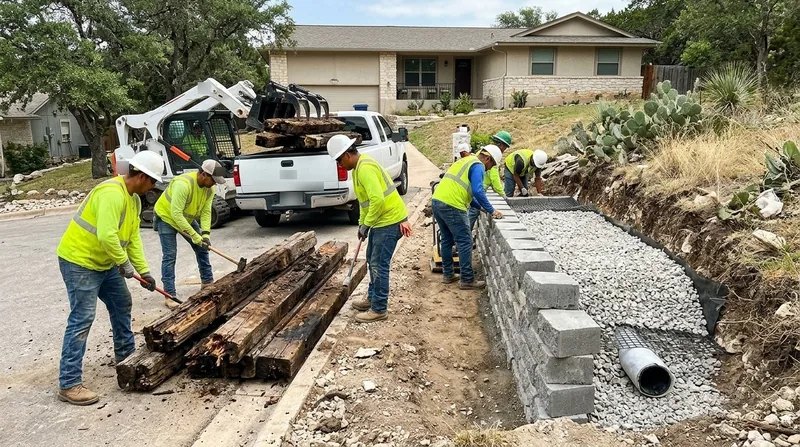




Railroad Tie Wall Replacement in Austin is one of the most common retaining wall jobs we handle, especially in neighborhoods built during the 1970s and 80s when creosote-treated railroad ties were the go-to material for hillside and slope retention. Austin's terrain splits sharply: west of MoPac, the Balcones Escarpment creates steep lots with thin rocky soil over Edwards limestone, where old tie walls fail under clay heave and drought stress; east of I-35, the Blackland Prairie's black expansive clay swells after flash floods and shrinks in dry spells, collapsing tie walls built without proper drainage. These aging walls rot from the inside out, lean dangerously, and leak creosote into soil and groundwater. We remove the failed structure completely, haul away the toxic ties, install new gravel backfill and drainage, and rebuild with segmental block, poured concrete, or limestone that will hold for decades. Whether your wall is in Northwest Hills, Mueller, Westlake, or Pflugerville, we'll assess the site, pull permits if needed, and give you a realistic timeline and price. Call (737) 204-6261 for a free estimate, or read on to understand what the job involves.
Why Railroad Tie Walls Fail in Austin: Clay Heave, Creosote Rot, and Clogged Drainage
Railroad tie retaining walls were popular in Austin from the 1970s through the early 1990s because ties were cheap, readily available, and easy to stack. What homeowners and contractors didn't fully account for was Austin's unique soil chemistry and weather extremes. The black Blackland Prairie clay that dominates east of I-35 expands when wet and shrinks when dry, exerting enormous lateral pressure on backfill and pushing walls outward. West of MoPac, thin Edwards limestone soil over bedrock offers poor drainage, so heavy rains and flash floods saturate backfill and overload the wall structure. Creosote, the wood preservative used on railroad ties, leaches into soil and groundwater over time, and many ties are now 40 to 50 years old and structurally compromised.
- Tie walls built without a gravel drainage layer trap water behind the structure, increasing hydrostatic pressure and accelerating failure.
- Creosote-treated wood deteriorates faster in Austin's intense summer heat and periodic freeze-thaw cycles than contractors anticipated in the 1970s.
- Ties installed without proper setback from property lines create disputes when walls lean or fail, especially in subdivisions with strict HOA rules.
- Leaning and tilted tie walls pose safety risks to homeowners, visitors, and adjacent properties, and may require emergency repair or removal.
Recognizing these failure modes early can save you thousands in emergency repairs and soil stabilization work down the road.
Key info: Many Austin neighborhoods built in the 70s and 80s, including parts of Westlake, Barton Hills, Mueller, and Pflugerville, are now seeing widespread tie wall failures. If your wall is leaning, weeping water, or showing signs of rot, contact us for a free inspection. We document the problem, recommend a solution, and handle all permitting and removal.
For more information on the broader failure modes affecting retaining walls in Austin, see our page on Leaning and Collapsed Wall Repair. You can also consult the City of Austin Development Services for permitting thresholds and setback requirements in your area.
How We Replace a Failed Railroad Tie Wall: Step-by-Step Process in Austin
Our railroad tie wall replacement process begins with a site walk and assessment. We measure the wall height, check the property line and setback distance, evaluate soil and drainage conditions, and identify any utilities or structures near the site. If the wall is over roughly 4 feet tall or supports a driveway, we confirm with your local building department whether a permit and engineered drawings are required. Some Austin jurisdictions, including the City of Austin and Round Rock, have specific thresholds. Once we have clarity on permits, we schedule the demolition and removal, haul away the old ties as hazardous waste (creosote is regulated), prepare the foundation, install new backfill and drainage materials, and build the new wall to code and your site conditions.
- We obtain a site survey and confirm property lines and setback distances before any work begins.
- We pull a permit from your local building department if required, and coordinate inspections throughout the project.
- We demolish and remove the old tie wall, haul away creosote-treated wood as hazardous material, and dispose of it properly.
- We excavate and prepare a level, compacted foundation footing to the depth and width required by code.
- We install a gravel backfill layer and perforated drainage pipe to manage groundwater and prevent future hydrostatic buildup.
- We build the new wall in your choice of segmental block, poured concrete, or limestone, set to the correct batter (angle) and height.
- We backfill and compact new gravel, test drainage, and clean up the site completely.
The entire process typically takes 2 to 4 weeks depending on wall size, permitting, and weather.
Example: A homeowner in Northwest Austin had a 30-foot-long, 3-foot-tall tie wall running along her driveway in Westlake. The wall was leaning inward and weeping water. We pulled a permit (required because it supported a driveway surcharge), removed the old ties over 2 days, installed 4 inches of perforated drainage pipe and 2 feet of compacted gravel backfill, and rebuilt in segmental block over 3 days. Total time: 12 days. The new wall is level, drains cleanly, and is warrantied for 20 years.
Learn more about Retaining Wall Replacement and the range of materials we offer. If you have questions about permitting or want to understand your options, contact us for a free estimate.
Railroad Tie Wall Replacement Methods: Comparing Your Options
| Approach | Description | Best for |
|---|---|---|
| Segmental Block (SRW) | Modular concrete blocks stacked and pinned with reinforcement. Clean aesthetic, easy to repair, excellent drainage. Blocks are typically 12 inches wide and 6 inches tall. | Most residential jobs in Austin. Works well on slopes, driveways, and property lines. Popular in Mueller, Cedar Park, and Pflugerville subdivisions. |
| Poured Concrete | Monolithic concrete wall, reinforced with rebar and wire mesh. Very strong, long-lasting, minimal maintenance. Requires careful forming and curing, especially in Austin heat. | Tall walls (over 4 feet), high-load applications, and sites where a seamless, finished look is desired. Common in Barton Hills and Westlake. |
| Austin Limestone | Chopped or stacked limestone blocks, quarried locally. Blends with natural landscape, excellent durability in Austin's soil. Can be laid dry-stack or mortared. | Properties west of MoPac where Edwards limestone is native. Aesthetic match to existing landscape and home architecture. Northwest Hills and Westlake are ideal candidates. |
| Timber (New Cedar or Pressure-Treated) | Modern pressure-treated lumber or cedar, installed with proper drainage and setback. Warrantied for 10 to 15 years. Not creosote-treated. Requires periodic inspection and maintenance. | Homeowners who prefer a wood aesthetic and are willing to maintain the wall. Typically used for shorter walls under 3 feet. Less common in Austin now due to durability concerns in our climate. |
Railroad Tie Wall Replacement Cost in Austin: What to Expect
The cost of railroad tie wall replacement in Austin typically starts at $35 per square foot of wall face and can range from $30 to $50 per square foot depending on material choice, wall height, site access, soil conditions, and permitting complexity. A 30-foot-long wall that is 3 feet tall covers 90 square feet of face area, so you can expect a starting estimate in the range of $2,700 to $4,500 before any site-specific factors are added. The largest cost drivers are the choice of material (segmental block is typically less expensive than poured concrete or Austin limestone), the depth of new backfill and drainage required, whether a permit and engineered drawings are needed, and the difficulty of access for equipment and debris removal.
Walls on steep hillsides west of MoPac, or in tight residential lots in Mueller or Pflugerville, may cost more because equipment access is limited and hand labor increases. Walls that require engineered drawings and multiple city inspections add permit and design costs of $500 to $2,000. Haul-away of creosote-treated wood is included in our price and handled as hazardous waste. We always recommend getting 2 to 3 estimates from licensed contractors, asking for a detailed scope of work and material breakdown, and verifying that the contractor holds current Austin-area business licenses and liability insurance.
For a detailed pricing breakdown and to discuss your specific project, visit our pricing page or call (737) 204-6261 for a free, no-obligation estimate. We respond within 24 hours and can often schedule a site visit within 48 hours.
Railroad Tie Wall Replacement Near Me: What Austin Homeowners Should Know When Hiring a Contractor
Choosing the right contractor for railroad tie wall replacement is critical because the work involves demolition, hazardous material handling, permitting, and structural engineering. Ask for references from recent jobs in your neighborhood (Northwest Hills, Westlake, Mueller, Cedar Park, and Pflugerville are all common job sites for us). Check online reviews and ask whether the contractor has experience with Austin's specific soil types and permitting requirements. Many Austin jurisdictions require a permit for walls above roughly 4 feet or walls that support a driveway or structure; the threshold varies by city, so your contractor should confirm this with your local building department before giving you a final price.
- Verify that the contractor is licensed, insured, and bonded in Texas and holds all required local business licenses.
- Ask for 2 to 3 references from completed jobs in Austin and check them thoroughly for quality and timeline adherence.
- Confirm that the contractor will pull all required permits and coordinate with the local building department for inspections.
- Discuss whether your wall is protected or subject to HOA rules, and ensure the contractor understands any aesthetic or setback requirements.
- Request a written estimate that breaks down material, labor, permits, and haul-away fees separately so you can compare accurately.
- Ask about the warranty on the new wall and what is covered (materials, workmanship, drainage performance) for how long.
A reputable contractor will be happy to answer these questions and provide proof of credentials on request.
Red flags: Beware of contractors who quote a price without a site visit, offer unusually low bids without detail, refuse to pull permits, or cannot provide recent local references. Creosote-treated wood disposal is a regulated hazardous waste process; if a contractor doesn't mention proper haul-away, they may be cutting corners on environmental compliance.
Contact us today to discuss your wall and get a detailed estimate with no obligation.
Railroad Tie Wall Replacement in Austin: Pricing Guide
| Service | Price | Details |
|---|---|---|
| Segmental Block Wall Replacement | Starting at $35/sq ft | Most common choice in Austin. Includes demolition, haul-away, drainage, and new block installation. Price increases with wall height and access difficulty. |
| Poured Concrete Wall Replacement | Starting at $40/sq ft | Monolithic concrete structure with rebar reinforcement. Stronger than block, ideal for tall or high-load walls. Requires forming and curing time. |
| Austin Limestone Wall Replacement | Starting at $45/sq ft | Local limestone sourced and installed. Premium aesthetic, excellent durability west of MoPac. Includes demolition, drainage, and stone placement. |
| Complex or Large-Scale Replacement | On estimate | Walls over 6 feet tall, multiple tiers, engineered drawings required, or difficult site access. Requires on-site assessment before pricing. |
| Permit and Engineering (if required) | $500 to $2,000 | Varies by jurisdiction and wall height. Austin and Round Rock thresholds differ. We coordinate with building department and include in final invoice. |
| Free Estimate | No charge | Site visit, measurements, material recommendations, and detailed written quote. Response within 24 hours. Call (737) 204-6261 to schedule. |
Indicative pricing, the exact cost depends on square footage, finish, and site access. Free personalized estimate within 24h at (737) 204-6261.


