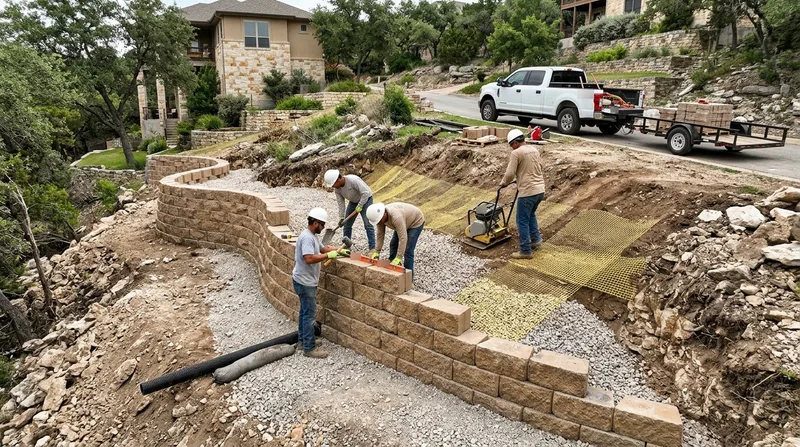




Retaining Wall Installation in Austin demands more than a straight concrete pour and backfill. Austin straddles the Balcones Escarpment, meaning half the city sits on thin rocky soil over Edwards limestone on steep hillsides west of MoPac, while the other half rides on black expansive clay that heaves in drought and swells after storms. Your driveway slope, terraced yard, or cut-and-fill pad needs a wall engineered for both the terrain under your feet and the Central Texas downpours that overload backfill drains. We design and build new retaining walls with proper footings, gravel drainage, and sizing that handles everything from limestone hillsides to clay-heavy lots across Austin, Round Rock, Cedar Park, and the surrounding region. Whether you need a wall to hold a sloped driveway, terrace a yard, or stabilize a creek-side lot, we start with the soil, the water, and the site itself.
Why Retaining Wall Installation Matters on Austin Hillsides and Clay Lots
Austin's two geologies create two very different wall challenges. On the west side, limestone hillsides and thin soils mean walls must anchor deep into bedrock or competent soil, handle seasonal drought cracking, and resist the bright sun that bakes exposed faces. On the east side, Blackland Prairie clay expands and contracts with rainfall, pushing walls outward and upward in wet seasons. Both conditions demand proper drainage, correct footing depth, and engineered backfill from day one. A wall that ignores these realities fails within five to ten years, leaning, cracking, or collapsing after heavy rain or prolonged drought.
- We excavate footings below the frost line and into stable soil or bedrock, preventing heave and settlement.
- We install perforated drain pipe and gravel backfill sized for Central Texas 100-year storm runoff, not generic rainfall.
- We choose materials and slopes matched to your soil type, whether limestone, clay, or mixed fill.
- We verify setback and property-line requirements with your local building department before we stake the wall.
- We obtain permits for walls above roughly 4 feet or walls that support a driveway, structure, or other surcharge.
A properly installed wall stops erosion, prevents flooding, and holds your yard in place for decades.
Key info: Austin's building departments (City of Austin, Round Rock, Cedar Park, Pflugerville, and others) require permits for most walls taller than 4 feet or any wall supporting a driveway. Engineered drawings are often required on hillside lots. Always verify with your local building department before digging. The City of Austin's Development Services page lists permit thresholds and design standards at austintexas.gov/development-services.
How We Design and Build Your Retaining Wall: Step by Step
Our process starts with the soil, not the wall. We visit your site, assess the terrain, test the soil bearing capacity, measure slopes and drainage patterns, and confirm setback and permit requirements with your local building department. From there, we design a wall that fits the ground and the water, then build it with precision footings, stable backfill, and drainage that works for decades.
- We conduct a site visit and soil assessment to determine footing depth, material choice, and drainage needs.
- We stake out the wall location, verify property lines, and confirm setback and permit requirements with the city.
- We obtain a permit if required (most walls above 4 feet or supporting a surcharge need one).
- We excavate the footing trench to stable soil or bedrock, sloped and compacted for even bearing.
- We build the wall face with your chosen material (poured concrete, segmental block, stone, or timber), keeping it plumb or slightly battered.
- We install perforated drain pipe at the base, wrap it in geotextile, and backfill with gravel and compacted soil in lifts.
- We finish the top with cap stone or coping and verify drainage flow away from the wall and your home.
The result is a wall that holds your yard, stops erosion, and survives Austin's heat, drought, and flash flood cycles.
Example: A Northwest Hills homeowner in Austin needed to terrace a steep limestone lot behind a 1980s ranch house. We excavated the footing 3 feet into competent limestone, built a 5-foot poured concrete wall with a battered face, installed 4-inch perforated drain and 2 feet of gravel backfill, and capped it with Austin limestone. The wall has held for twelve years through two 100-year storms and a severe drought. See also our work on concrete retaining walls and retaining wall drainage for more detail.
Retaining Wall Installation Methods and Materials for Austin Lots
Austin's mix of limestone, clay, and fill soils, combined with steep hillsides and flat prairie lots, means no single wall type works everywhere. We match material and method to your site conditions, budget, and aesthetic goals. Below are the main approaches we use on Austin properties.
| Approach | Description | Best for |
|---|---|---|
| Poured Concrete | Monolithic reinforced concrete wall, 6 to 12 inches thick, with integral footing and optional battered face or cap stone. | Hillside lots, tall walls (5 to 8 feet), high clay or unstable soil, areas where durability and low maintenance matter most. |
| Segmental Block (SRW) | Interlocking modular units, typically 12 inches wide, stacked with geogrid reinforcement and gravel backfill. | Medium walls (3 to 6 feet), newer subdivisions, sites where a finished block aesthetic fits the home, easier to repair one unit if needed. |
| Boulder and Natural Stone | Dry-stacked or mortared boulders and ledge stone, 18 to 36 inches thick, with gravel core and drainage. | Hillside terraces, creek-side lots, aesthetic match to limestone landscape, short to medium walls (2 to 5 feet). |
| Timber (Cedar or Pressure-Treated) | 6x6 or 6x8 timbers bolted together with deadmen anchors, gravel backfill, and drain pipe. Cedar weathers naturally; pressure-treated lasts longer. | Short walls (2 to 4 feet), rustic or naturalistic yards, budget-conscious projects, though timber requires more maintenance than concrete. |
Each method has trade-offs in cost, durability, aesthetics, and maintenance. We recommend the material that matches your soil, slope, climate exposure, and long-term expectations.
Retaining Wall Installation Cost in Austin: What to Expect
Retaining wall installation pricing in Austin starts at around $30 per square foot for basic segmental block or timber walls on stable, accessible sites. Poured concrete, natural stone, and engineered designs on difficult terrain, clay lots, or hillsides typically run $40 to $60+ per square foot. The final cost depends on footing depth, soil conditions, drainage requirements, material choice, wall height, access, and whether a permit and engineered drawings are required.
A 30-foot wall 4 feet tall on an accessible lot with good soil and no major drainage work might run $3,600 to $4,800. A 20-foot wall 6 feet tall on a steep hillside with poor soil, engineered design, and full drainage system could easily cost $6,000 to $10,000 or more. Always get two to three detailed estimates from licensed contractors so you understand what's included at each price point. Cheap estimates often skip proper footing depth, drainage, or compaction, leading to failure within five years. Investing in proper design and installation now saves tens of thousands in repair or replacement later.
For a detailed pricing breakdown and to understand the factors that move your estimate up or down, visit our full pricing page. We provide free estimates within 24 hours at (737) 204-6261, with no obligation to book.
What to Look for When Hiring a Retaining Wall Contractor Near Me in Austin
Finding a qualified retaining wall contractor near you in Austin means checking three things: licensing and insurance, experience on local terrain, and a clear understanding of permits and site conditions. A cheap estimate from an unlicensed crew is almost always a false economy. Here is what to verify before you hire.
- Request references from three to five recent Austin-area jobs, ideally on similar terrain (hillside, clay lot, or mixed soil) and material type (concrete, block, stone, or timber).
- Confirm that the contractor will obtain the permit (if required by your city) and work with your local building department on design and inspections.
- Ask whether they provide a detailed written estimate that breaks down footing depth, drainage, backfill, and material, not just a per-square-foot price.
- Verify that they understand your city's setback rules, property-line requirements, and any HOA restrictions on wall height, material, or appearance.
- Check whether they warranty the work (most reputable contractors offer a one-year workmanship guarantee and stand behind footing and drainage for five to ten years).
A licensed, experienced, and transparent contractor will take time to assess your site, explain the design, and answer your questions before you sign. Contact us for a free estimate and let us show you the difference that proper design and installation makes.
Retaining Wall Installation in Austin: Pricing Guide
| Service | Price | Details |
|---|---|---|
| Segmental Block Wall (3 to 4 feet) | Starting at $30/sq ft | Includes footing, block, geogrid, and gravel backfill on stable, accessible soil with standard drainage |
| Poured Concrete Wall (4 to 6 feet) | Starting at $40/sq ft | Reinforced concrete, integral footing, drain pipe and backfill, battered or vertical face, cap stone optional |
| Boulder and Natural Stone Wall (2 to 5 feet) | Starting at $45/sq ft | Dry-stacked or mortared stone, 18 to 36 inches thick, drainage core, material cost and labor intensive but long-lasting |
| Engineered Design and Hillside Installation | On estimate | Steep terrain, poor soil, tall walls, or city-required engineered drawings require site assessment and custom design |
| Travel and Site Visit | Included | No mileage fee within Austin service area, included in estimate and final invoice |
| Free Estimate | Free | Response within 24 hours, detailed site assessment, no obligation to hire, call (737) 204-6261 |
Indicative pricing, the exact cost depends on square footage, finish, and site access. Free personalized estimate within 24h at (737) 204-6261.


