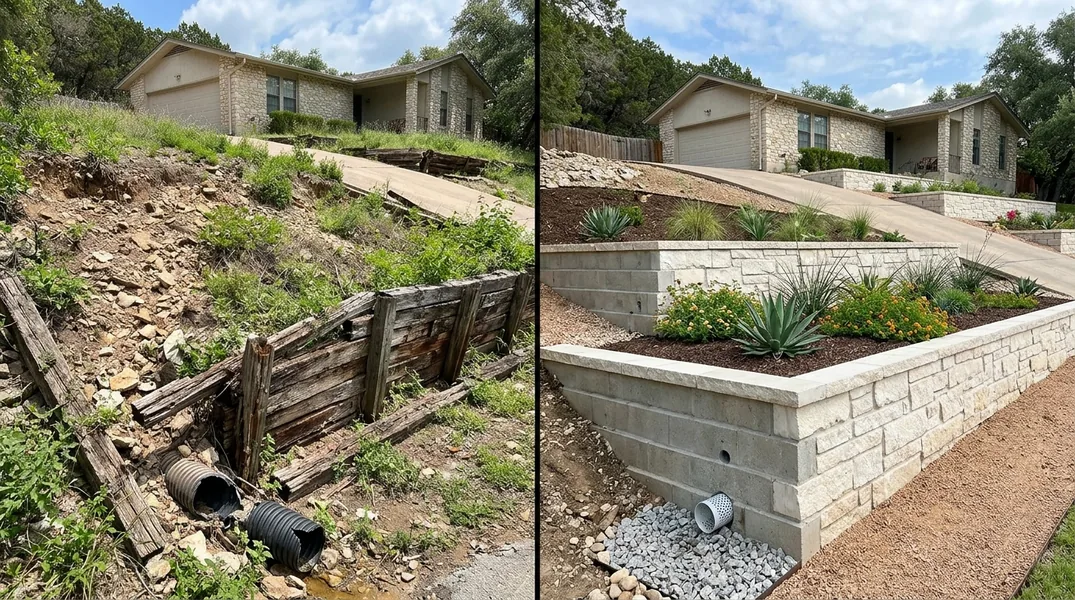
Understanding Austin's Unique Soil Challenges
Austin sits atop some of Texas's most challenging terrain. The expansive clay soils and limestone bedrock that define the Hill Country create significant pressure on retaining walls. Expansive clay swells when wet and shrinks when dry, creating lateral forces that can crack, shift, or topple poorly designed structures. This natural cycle happens year-round in our climate, making material selection not just a preference but a necessity for durability.
Homeowners and property managers across Austin often discover these problems the hard way. A wall that looks fine in summer may develop serious issues after spring rains. The limestone bedrock, while beautiful, adds another layer of complexity. Walls must either anchor securely into this hard layer or account for its immovability. Understanding these geological realities helps explain why certain materials consistently outperform others in our region.
Concrete Retaining Walls: Strength and Durability
Concrete Retaining Walls remain one of the most popular choices for Austin properties, and for good reason. Poured concrete creates a monolithic structure that resists the expansive forces of clay soil far better than lighter materials. When properly engineered with adequate reinforcement and drainage, concrete walls can last 40 to 50 years or more, even in our demanding climate. The material's compressive strength allows it to handle the weight of soil and the lateral pressure that comes with steep hillsides.
The key to concrete success in Austin is proper installation. Drainage behind the wall is absolutely critical. Without it, water accumulates and amplifies the pressure from expanding clay. A well-designed concrete wall includes a perforated drain pipe, gravel backfill, and often a geotextile membrane to direct water away from the structure. This attention to detail separates a wall that lasts decades from one that fails within years. Many homeowners are surprised to learn that the wall itself is only part of the solution; the hidden drainage system is equally important.
Block Retaining Walls and Segmental Systems
Retaining Wall Installation using concrete blocks and segmental systems offers flexibility that poured concrete cannot match. These modular units can be stacked to create walls of varying heights and can follow the contours of your landscape more easily. Segmental retaining walls, often called SRWs, use interlocking blocks that distribute loads across multiple units rather than concentrating stress in one continuous structure. For Austin's clay and limestone terrain, this distribution of force can be advantageous, especially when walls are built on slopes or uneven ground.
Block retaining walls also allow for easier repairs and adjustments. If one section needs attention, you can replace individual blocks without dismantling the entire structure. This modularity has made block walls increasingly popular for residential applications across the region. However, segmental walls still require excellent drainage and proper base preparation. The blocks themselves must be high-quality concrete units rated for structural use, not decorative blocks. When installed correctly with appropriate backfill materials and drainage systems, block walls perform exceptionally well in Austin's climate and can rival poured concrete in longevity.
Limestone Retaining Walls: Natural Beauty with Practical Considerations
Limestone is native to the Austin area, and many homeowners are drawn to the aesthetic appeal of limestone retaining walls. A limestone wall fits naturally into the Hill Country landscape and offers undeniable curb appeal. However, limestone presents unique challenges that concrete and block systems do not. Natural stone is subject to weathering, spalling (flaking), and erosion over time. The freeze-thaw cycles we experience, combined with our periodic heavy rains, can gradually degrade limestone surfaces. Additionally, limestone is more porous than concrete, which means water penetration is a greater concern.
If you choose limestone for your retaining wall, plan for ongoing maintenance. Sealing the stone helps protect against water damage and weathering. Proper drainage behind the wall becomes even more critical with stone construction. Many Austin homeowners opt for a hybrid approach: a sturdy concrete or block core with a limestone veneer face. This gives you the natural stone appearance you want while maintaining the structural integrity needed to handle our soil conditions. Before committing to a full limestone wall, discuss the long-term maintenance requirements and realistic lifespan with a professional installer who understands Austin's climate.
Retaining Wall Installation Cost in Austin: What to Budget
The pricing for retaining wall projects varies significantly based on material choice, wall height, soil conditions, and site accessibility. Concrete walls typically range from $50 to $150 per linear foot, depending on height and complexity. Segmental block walls often fall in the $40 to $120 per linear foot range, while limestone veneer can push costs higher due to material and labor intensity. These figures are estimates; actual costs depend on your specific property and the engineering required for Austin's unique geology.
Several factors influence final costs beyond the wall material itself. Drainage systems, which are non-negotiable for durability in Austin's clay soil, add expense but prevent far costlier failures down the road. Site preparation, including excavation and removal of existing material, affects labor time. If your property has limestone bedrock near the surface, drilling and anchoring requirements increase costs. Obtaining proper permits and engineering plans, while mandatory in Austin, also factor into your budget. The best approach is to request a free estimate from Austin Retaining Wall. Our team can evaluate your specific situation and provide transparent pricing based on what your property actually needs.
When to Call a Professional: Retaining Wall Installation Near Me
DIY retaining walls rarely succeed in Austin's challenging soil environment. The combination of expansive clay, limestone bedrock, and our climate demands expertise that goes beyond stacking materials. Improper installation leads to cracking, bowing, tilting, or complete failure within a few years. Once a wall fails, Retaining Wall Repair or Retaining Wall Replacement becomes far more expensive than getting it right the first time. Professional installers understand soil mechanics, drainage design, and local building codes. They know which materials work best in specific locations and how to engineer walls that stand for decades.
Austin Retaining Wall has served the local community with expert installation, repair, and replacement services. Our team understands the geological and climatic challenges unique to this region. We handle everything from initial site assessment and engineering to final drainage verification. Whether you need a new wall, repairs to an existing structure, or complete replacement, our professionals deliver solutions built to last. If you're considering a retaining wall project or concerned about an existing wall's condition, contact Austin Retaining Wall today at (737) 204-6261 or request a free estimate online. We serve Austin and the surrounding areas with quality workmanship and transparent communication.
Looking for a professional retaining wall contractor in Austin? Austin Retaining Wall responds fast for all your retaining wall needs.
Get a Free QuoteOur services: Retaining Wall Installation · Retaining Wall Repair · Retaining Wall Replacement