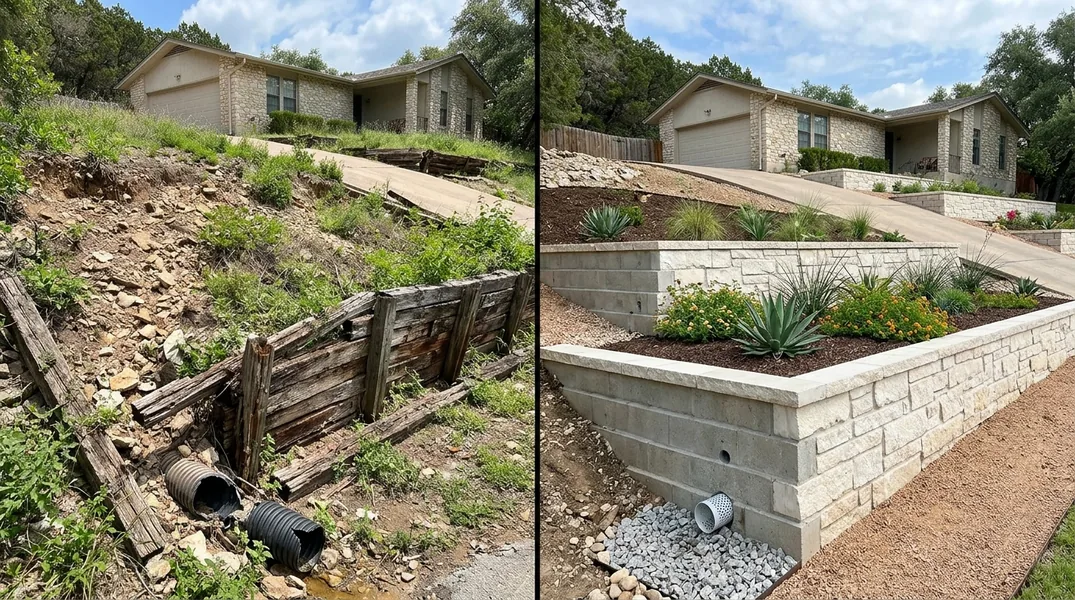
Why Austin's Soil Is Uniquely Challenging for Retaining Walls
If you own property in Austin, you've likely noticed the distinctive reddish clay that dominates the landscape. This soil composition, combined with the region's limestone bedrock, creates a perfect storm for retaining wall problems. Unlike sandy or well-draining soils found in other parts of the country, Austin's clay expands when wet and contracts when dry, placing enormous lateral pressure on retaining walls year-round.
The limestone layer beneath the clay adds another complication. When water infiltrates behind a retaining wall, it can dissolve pockets in the limestone or create hydrostatic pressure that pushes against the wall structure with tremendous force. During Austin's wet season, this pressure intensifies dramatically. A wall that appears stable in summer may be on the verge of failure by winter. This is why so many homeowners in the area discover Retaining Wall Repair needs they didn't anticipate.
The Most Common Warning Signs of a Failing Retaining Wall
A leaning retaining wall is often the first visible sign that something is wrong. If your wall is tilting away from the soil it's supposed to hold back, the structural integrity is already compromised. This lean typically develops gradually over months or years, so catching it early makes a significant difference. You might also notice horizontal cracks running across the face of the wall, or vertical cracks that suggest the wall is separating under pressure.
Another critical warning sign is water seeping or pooling behind the wall. Proper drainage is essential to retaining wall longevity, and when water accumulates, it's only a matter of time before failure occurs. If you see wet spots on the back side of your wall, or if soil behind the wall is noticeably softer and muddier than it should be, water management has failed. A bowing retaining wall is perhaps the most urgent warning sign. When the face of the wall curves outward, it means the soil pressure has overcome the wall's structural capacity. This requires immediate professional attention.
Settling or displacement at the base of the wall, tilting fence posts attached to the wall, or gaps opening between the wall and adjacent structures all indicate progressive failure. Don't wait for the wall to collapse. Contact Austin Retaining Wall at (737) 204-6261 to schedule a free estimate as soon as you notice any of these signs.
How Poor Drainage Accelerates Wall Failure
Drainage is the silent killer of retaining walls in Austin. Many homeowners don't realize that a retaining wall isn't just about holding back soil. It's also a water management system. If water cannot flow freely through or behind the wall, hydrostatic pressure builds up and pushes outward with tremendous force. In Austin's clay-heavy environment, this is especially destructive because clay is naturally impermeable.
When Retaining Wall Installation is done without proper drainage considerations, water collects behind the wall during heavy rains. The clay soil becomes saturated and heavier, pressing harder against the wall structure. Over time, this repeated cycle of saturation and drying weakens the wall's foundation and causes it to lean, bow, or crack. Professional Retaining Wall Repair often involves installing or improving drainage systems, including perforated drain pipes, gravel backfill, and sometimes French drains to redirect water away from the wall.
Material Choices Matter: Why Some Walls Fail Faster Than Others
The material used to build your retaining wall significantly affects how well it withstands Austin's challenging soil conditions. Wood retaining walls, while affordable and aesthetically pleasing, are particularly vulnerable to failure in clay-rich environments. Wood absorbs moisture, rots, and loses structural integrity relatively quickly. Stone and brick walls can shift and settle unevenly as clay expands and contracts beneath them.
Concrete Retaining Walls offer superior durability and strength, especially when properly reinforced and designed with adequate drainage. Concrete resists the constant pressure exerted by clay soil better than most alternatives. However, even concrete walls can fail if they weren't installed correctly or if drainage wasn't considered during the original design. If your existing wall is showing signs of failure and was built with less durable materials, Retaining Wall Replacement with a concrete solution may be the most cost-effective long-term choice.
Professional Inspection and Repair Options Near Me
If you've spotted warning signs of a failing retaining wall, the next step is a professional inspection. Austin Retaining Wall provides comprehensive assessments that identify the root cause of failure, whether it's poor drainage, inadequate structural design, soil pressure, or material degradation. During an inspection, our team evaluates the wall's lean, checks for cracks and displacement, assesses drainage conditions, and examines the soil composition behind the wall.
Depending on the severity and cause of failure, repair options range from installing new drainage systems and adding reinforcement to complete wall reconstruction. Minor issues caught early might require only targeted repairs and improved drainage. More serious problems, such as a severely bowing retaining wall, may necessitate Retaining Wall Replacement. Our team will recommend the most practical and cost-effective solution for your specific situation. To discuss your wall's condition and get a professional assessment, reach out to Austin Retaining Wall at (737) 204-6261 or request a free estimate online.
Retaining Wall Repair Cost in Austin: What to Budget
The cost of Retaining Wall Repair in Austin depends on the extent of damage, the wall's size, and the repair method required. Minor repairs, such as fixing localized cracks or installing new drainage, typically cost less than major structural work. A small drainage improvement might range from a few hundred to a couple of thousand dollars. More extensive repairs, such as adding reinforcement or rebuilding sections of the wall, can cost significantly more.
Complete Retaining Wall Replacement is generally more expensive upfront but often represents the best value if the existing wall is severely compromised. Rather than repeatedly patching a failing wall, replacement with a properly designed, durable solution prevents future problems. Factors affecting pricing include the wall's linear footage, height, material choice, site accessibility, and the complexity of drainage work required. To understand the investment needed for your specific situation, contact Austin Retaining Wall for a detailed free estimate. We'll provide transparent pricing and explain exactly what work is necessary to restore your wall's integrity.
Looking for a professional retaining wall contractor in Austin? Austin Retaining Wall responds fast for all your retaining wall needs.
Get a Free QuoteOur services: Retaining Wall Installation · Retaining Wall Repair · Retaining Wall Replacement